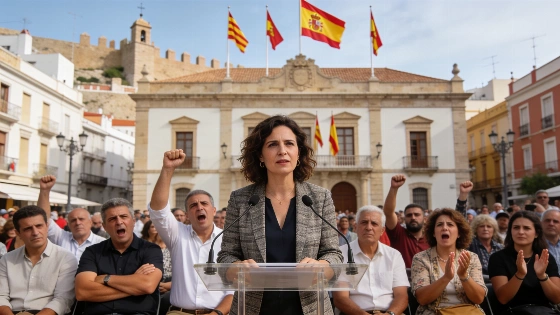
Tensions flared at Melilla’s official celebration as Minister Elma Saiz was loudly booed while PP leader Alberto Núñez Feijóo received applause. The city’s president accused Madrid of inaction and demanded the return of undocumented migrants.
Melilla’s annual Day ceremony quickly turned contentious when Social Security and Migration Minister Elma Saiz was met with loud boos and chants of “fuera, fuera” from the crowd. Moments later, the same audience applauded Partido Popular leader Alberto Núñez Feijóo as Melilla’s president, Juan José Imbroda, introduced both politicians at the start of his speech.
Imbroda, who leads the autonomous city, used his address to sharply criticize the central government’s handling of the recent border crisis. He accused Pedro Sánchez’s administration of standing by while, in his words, an “invasion” unfolded, and said Morocco had shown “active passivity.” Imbroda argued that Ceuta and Melilla should not be left to deal with the consequences alone. He warned against turning Ceuta into a large migrant reception center and called for the return of everyone who entered illegally.
Elma Saiz’s participation in the Melilla Day events on September 17, 2026, was officially announced in advance by the government’s local representative.
Imbroda also addressed ongoing tensions with Morocco, saying Melilla has faced “disdain and hostile actions” despite efforts to maintain good relations. He claimed that Spanish concessions have only led to more pressure from Morocco, and dismissed Moroccan claims to Melilla and Ceuta as “spurious arguments” driven by “annexationist ambitions.” When Imbroda stated that Melilla’s sovereignty is as legitimate as Madrid’s, the audience responded with rare unanimous applause.
After the ceremony, Feijóo called for a stronger state presence in both Melilla and Ceuta, describing Imbroda’s speech as courageous and heartfelt. He pointed to a recent Brussels resolution that recognized the events in Ceuta as an invasion and confirmed that both cities are part of Europe, with a direct call for the immediate return of all undocumented entrants. Feijóo urged Morocco to fulfill its commitments and accept the return of migrants “within days,” saying that while relations should be based on “absolute cordiality and reciprocal loyalty,” Spain must be firm when that loyalty is not reciprocated.
The split in public reaction at the event highlights the deep political divide over Spain’s border policy and its relationship with Morocco. The demand for immediate migrant returns and criticism of Madrid’s approach echo concerns in Ceuta, where, as reported earlier, security and migration policy remain under scrutiny.
On September 17, 2026, the European Parliament adopted a resolution describing the mass crossings into Ceuta as 'instrumentalization of illegal migration' and 'hybrid warfare,' urging the acceleration of migrant returns and stronger protection of the EU’s external borders.
European Parliament
Melilla’s situation reflects the broader challenges facing Spain’s North African enclaves. The city’s leaders are pushing for a tougher national and European response, while local opinion appears increasingly divided. The crowd’s applause for the opposition and hostility toward the government’s representative point to growing frustration with what many see as inaction and a demand for concrete solutions. As debates over sovereignty, migration, and relations with Morocco continue, the events in Melilla are likely to shape Spain’s border politics in the coming months.