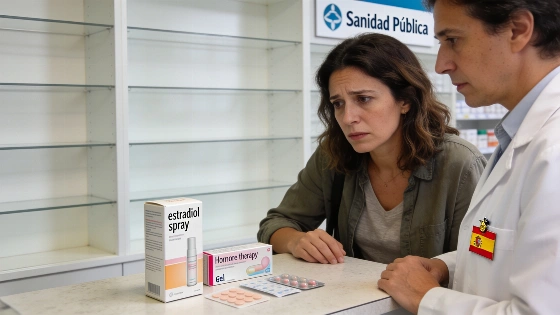
Companies selling menopause hormone alternatives have declined public funding. Supply failures are squeezing patches and sprays while Sanidad searches for another way forward.
In Spain, companies behind alternative menopause hormone treatments have told the Ministry of Health they do not want public financing for their medicines. Many women now face symptoms without steady access to treatment. Talks with Sanidad have not secured the products' entry into the National Health System's pharmaceutical coverage.
The problem is no longer limited to one medicine. The Agencia Española de Medicamentos y Productos Sanitarios, known as AEMPS, said the companies were not interested in public funding. Sanidad is still studying ways to keep enough therapeutic alternatives available.
AEMPS has listed Lenzetto as a medicine with supply problems since 16 March 2026. It is the only estradiol treatment in Spain administered as a spray; other alternatives are available as patches or gels.
Without an agreement on price and reimbursement, patients may have to pay for some alternatives themselves. Recent reports say no company has formally asked for the new alternatives to be added to the SNS reimbursement system.
Public coverage would mean the state paid all or part of the treatment after agreeing on a price. It could also drive up demand and require manufacturers to raise production. Drugmakers may not be able to add that capacity at once. The financing dispute has created a second pressure point.
The shortage began in March with problems affecting the Lenzetto estradiol spray. Doctors use it to relieve menopause symptoms, and it is also prescribed for trans women. Once Lenzetto became unavailable, many patients switched to other estradiol products. Some did not qualify for public reimbursement. Demand then put pressure on funded transdermal patches such as Evopad, which also began to face stock problems.
AEMPS has said patches and gels could partly meet the need. The surge in demand has affected the availability of some of those products too. The pressure is spreading.
Catalan authorities have authorised an emergency route for pharmacies to prepare magistral estradiol formulations for one month if normal supplies are not restored by the end of November. The measure reflects the pressure on both the spray market and alternative patches and gels, including reimbursed products.
Manufacturing plans offer no quick fix. The laboratory responsible for Estradot has announced that it will stop marketing the patches. Estraderm is expected to maintain sufficient supply.
Gedeon Richter, which is responsible for Lenzetto, has said deliveries will resume gradually from November and continue during 2027. AEMPS remains sceptical because earlier supply commitments were not met. Later reports have warned that shortages could last beyond the expected recovery period.
Sanidad has pointed to Oestraclin Gel as an available option. The transdermal gel has no reported supply problems, and its production has been increased to meet extra demand. An available product does not automatically solve the access problem. Reimbursement and manufacturing capacity are separate decisions.
The ministry is discussing financing options with laboratories. The companies have not yet submitted formal applications for public coverage. The latest developments follow months of supply problems affecting sprays, patches and gels.