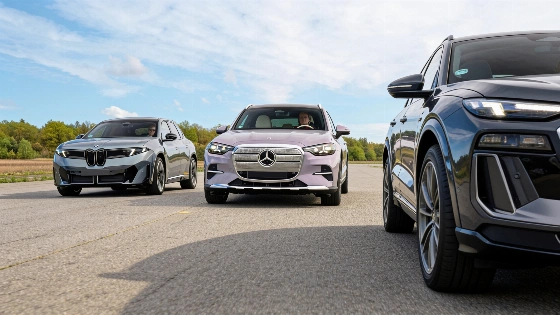
Audi Q6 e-tron, BMW iX3, and Mercedes GLC EQ represent the new elite of German electric SUVs. We compare their comfort, technology, performance, and range to see which model truly leads the segment.
Mercedes, Audi, and BMW have each launched new-generation electric SUVs, but only one can claim the top spot in the fiercely competitive premium segment. The Mercedes GLC EQ, Audi Q6 e-tron, and BMW iX3 all promise cutting-edge technology, strong performance, and the kind of comfort expected from Germany’s automotive elite. But how do they really compare when put to the test?
The Audi Q6 e-tron, the oldest of the trio, arrived in 2024 and quickly set a high bar for refinement. The BMW iX3, now built on the Neue Klasse platform, brings a fresh approach to electric driving, while the Mercedes GLC EQ is based on the all-new MB.EA-M architecture. All three offer spacious interiors, but each takes a different approach to comfort and design. The Mercedes stands out for its plush rear seats and AGR-certified front seats, which provide excellent support and comfort. Audi’s seats are among the best in the segment, with firm padding and impressive lateral support, while BMW’s optional M Sport seats are more divisive—offering strong side support but less comfort on long journeys due to their firmer, narrower design.
The premium electric SUV segment has become the new battleground for German automakers, where every detail—from seat comfort to battery chemistry—can decide market leadership.
Rear passengers in the BMW iX3 benefit from the only adjustable backrest in the group, making it a relaxed place to travel. However, the seat cushion is less padded, which can be felt on longer trips. In terms of cockpit technology, each brand has taken a distinct path. BMW introduces Panoramic Vision, a slim head-up display stretching across the lower windshield, customizable to show everything from trip data to battery temperature. Most controls are handled via a 17.9-inch central touchscreen, which is quick, bright, and packed with features, complemented by a responsive voice assistant.
Mercedes counters with its optional Hyperscreen, a massive 39.1-inch panel that merges the instrument cluster, central touchscreen, and a dedicated passenger display. The system is fast, colorful, and intuitive, with a voice assistant that responds promptly. Audi’s interior is more understated, featuring an 11.9-inch driver display, a 14.5-inch central touchscreen, and a 10.9-inch passenger monitor. While the graphics are more restrained, the system is well-organized and responsive, though its voice control lags behind the BMW and Mercedes in speed and fluidity.
Performance and Driving Dynamics
All three SUVs use an 800-volt architecture with dual electric motors, delivering instant acceleration and smooth power delivery. The Audi Q6 e-tron produces 462 hp, sprinting from 0 to 100 km/h in 4.8 seconds, with a top speed limited to 210 km/h. Its regenerative braking can be adjusted via steering wheel paddles, and the one-pedal driving mode is particularly effective. The Q6 feels agile for its 2.46-ton weight, with a pleasant steering feel and, when equipped with optional air suspension, a ride that balances comfort and control—though it doesn’t absorb bumps as softly as the Mercedes, it’s more forgiving than the BMW.
Braking performance is another key differentiator. The Audi stops from 100 km/h in 33.4 meters, just ahead of the BMW’s 33.9 meters, but both trail the Mercedes, which manages the same stop in just 31.6 meters. The BMW iX3 matches the Audi’s acceleration at 4.8 seconds to 100 km/h, with a slightly higher output of 469 hp. It’s the lightest of the three at 2.34 tons, making it the most agile in corners, aided by precise, quick steering. However, its steel suspension delivers a firmer, sportier ride that can feel harsh over rough surfaces, putting it behind the others in comfort.
Range and Efficiency
The Mercedes GLC EQ leads in outright power, with 489 hp and a unique two-speed gearbox that helps it achieve the fastest 0-100 km/h time of 4.2 seconds. Its regenerative braking is adjustable via paddles, and the one-pedal driving mode is both intuitive and effective. The test car featured air suspension and rear-axle steering, making it the most comfortable and surprisingly maneuverable of the group, despite its 2.56-ton weight.
Battery capacity and range are crucial for electric SUVs. The GLC’s 94 kWh battery delivered 479 km in real-world testing. The BMW iX3, with its larger 108.7 kWh battery, managed an impressive 535 km, while the Audi Q6 e-tron covered 460 km from its 94.9 kWh pack. Energy consumption was close between the BMW (21.9 kWh/100 km) and Mercedes (21.7 kWh/100 km), with the Audi slightly higher at 23.5 kWh/100 km.
Final Verdict
After extensive evaluation, the Mercedes GLC EQ emerges as the clear winner, offering the best blend of comfort, technology, and performance. The BMW iX3 impresses with its range and advanced electronics, while the Audi Q6 e-tron remains a refined and enjoyable option, albeit at a higher price point. For those interested in broader trends in electric mobility, the evolution of charging infrastructure—such as the innovative lamp post charging in London—offers a glimpse into how cities are adapting to the EV revolution, as explored in this recent analysis of urban charging solutions.
In summary: Audi Q6 e-tron takes third place (score: 8.5), BMW iX3 secures second (8.7), and Mercedes GLC EQ claims the top spot with a score of 8.9. Each model sets a new benchmark for what drivers can expect from premium electric SUVs, but Mercedes currently leads the pack.
Key context: All three models reflect a broader shift in the European car market toward electrification and digitalization. Their rapid development and competitive features highlight how quickly the premium EV segment is evolving, with German brands setting the pace for the rest of the industry.