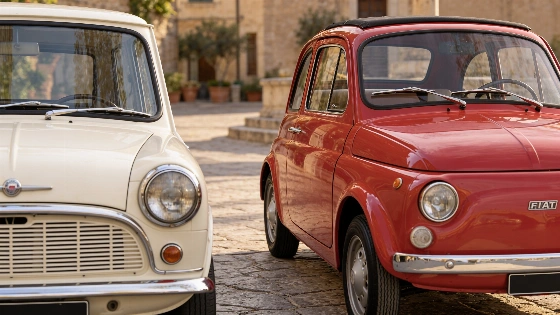
The MINI and Fiat 500 changed how Britain and Italy moved. Both became icons, but their original stories took very different turns. Which one really set the standard for small cars?
In the late 1950s, two tiny cars rolled onto European streets and changed everything. They did more than move people. They changed how cars were built and what they meant to their countries. Today, their names still draw crowds in showrooms. Now they come as electric or hybrid models. But the old rivalry between these two legends is still alive.
Both cars came from hard times. But their designs could not have been more different. The MINI, launched in 1959 by the British Motor Corporation, was the work of Alec Issigonis. It broke the mold. The car had a transverse engine and front-wheel drive. This setup squeezed the most space out of a body just 3.05 meters long. It set the pattern for small cars everywhere. At launch, the MINI cost 496 pounds in the UK. That’s about 546 euros at a straight conversion. Of course, inflation means the real cost would be much higher today.
In September 2026, Stellantis and FIAT publicly celebrated the 70th anniversary of the Fiat 500 at Vogue World: Milano, highlighting the model's enduring cultural status.
The Fiat 500 hit Italian roads first, in 1957. Dante Giacosa designed the “Nuova 500” with a tiny rear engine and simple mechanics. Its first price was 490,000 lira. That’s about 253 euros at the fixed euro rate. It was much cheaper than the MINI. The Fiat 500’s low price and simple build made it a hit. It sold over 3.8 million units from 1957 to 1975. It became the symbol of Italy’s postwar boom.
Spain’s story is different. The Renault 5 and Fiat Panda became household names thanks to local factories. But the original Fiat 500 never made it to Spanish buyers. Franco-era import rules kept it out. The SEAT 600 took its place as the people’s car. The MINI did reach Spain. Authi built it in Pamplona, first as the Morris Mini 1275 C in 1968. That model cost over 120,000 pesetas. Later, the Mini 850 arrived in 1970 for 80,000 pesetas—about 481 euros at the fixed rate. Again, these numbers don’t show the real buying power of the time.
The MINI’s real legacy is technical. Issigonis’s front-wheel drive, transverse engine layout became the world standard for small cars. The MINI was nimble and quick. It even won the Monte Carlo Rally in the 1960s. The Fiat 500’s rear-engine design could not match that. In engineering, the MINI changed the game.
According to recent reports, Stellantis prepared a new production halt for the Fiat 500 line at the Mirafiori plant in autumn 2026, reflecting ongoing restructuring and the shift in demand toward electric and hybrid versions. This highlights how the future of the 500 series is closely tied to evolving market trends and manufacturing strategies.
But if you measure by culture and how a car moved a nation, the Fiat 500 stands alone. Its air-cooled two-cylinder engine was cheap to run and easy to fix. That mattered for millions of Italian families. The 500’s shape became a national icon. Everyone in Italy knows it. It’s part of the country’s memory.
Most classic cars disappear for decades before a comeback. Not these two. The MINI and Fiat 500 never left. They kept changing. BMW brought back the MINI in 2001. Fiat relaunched the 500 in 2007 with a retro look. Now both offer electric and hybrid versions. They keep their spirit but fit the times. This constant reinvention sets them apart from other classics. Spain’s own icons, like the SEAT 600, faded away for years. The MINI and 500 stayed on the road.
So who wins? The MINI led the way in engineering. The Fiat 500 won more hearts and sold more cars in its first run. Both set the bar for small cars: practical, unique, and full of character. They keep evolving. Now they’re electric, but you can still spot them a mile away. True icons never really disappear. They just keep rolling.