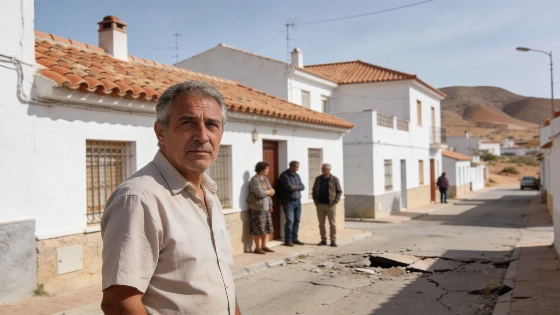
The Instituto Geográfico Nacional (IGN) recorded a magnitude 3.7 earthquake at 20:53 on Thursday, 13 August 2026, near La Ballabona in the Levante Almeriense, close to Antas. The tremor was felt in roughly 20 towns, including Cuevas del Almanzora and Vera. Residents also felt it in Huércal-Overa and parts of the Region of Murcia. No injuries or impressive material damage were reported.
More than a dozen aftershocks followed in the hours after the quake, which was the strongest event in the local sequence at the time. Residents in Cuevas del Almanzora and nearby areas, including Aljarilla, Jucainí and Palomares, said they felt it particularly strongly. The tremor was also perceptible in El Pilar de Huércal-Overa and Vera’s Parrilla development.
The IGN’s macroseismic questionnaire lets people who felt an earthquake describe their location and what they were doing, as well as report whether objects moved or fell. These observations help assess local effects. Magnitude measures the size of an earthquake, while intensity describes how strongly people experience it in particular locations. The two are related but measure different things.
On the logarithmic magnitude scale, a magnitude 4 earthquake releases about 100 times more energy than a magnitude 2 event. The 13 August tremor was reported as the area’s most impressive in the preceding six months, surpassing the magnitude 2.7 earthquake recorded on 4 July. The aftershocks and wider pattern of tremors reflect recurring seismic activity in the Levante Almeriense.
Activity continued later in the year. Three earthquakes were recorded between the night of 18 October and the early morning of 19 October. The sequence began with a magnitude 2.8 quake in Bédar, followed by a magnitude 1.9 there; a magnitude 3.4 event struck Los Gallardos at 05:31. The October earthquake was felt in 22 municipalities, with a maximum reported intensity of IV on the European Macroseismic Scale. La Voz del Sur quoted the IGN classification “ampliamente observado,” describing shaking felt indoors with moderate vibration and not normally associated with damage. No injuries or impressive material damage were reported.
The two measurements explain how an earthquake can be felt across a wide area without causing damage. Magnitude characterizes the event itself; intensity varies from place to place. For the October 19 earthquake, reported intensities ranged from IV in Arboleas and Lubrín to II to III in Antas. Similar readings were reported in Vera and Mojácar. The August event was also widely felt, but no impressive damage was reported.
Although the recent earthquake caused no reported damage, it has drawn attention to the wider context of weather and natural events affecting Spain. For example, recent severe storms and hail in northern and eastern Spain have also tested local emergency services and highlighted the importance of preparedness for natural phenomena.
Parts of Andalusia and Murcia experience occasional earthquakes. The IGN monitors seismic activity and encourages people to report tremors they feel. These accounts help characterize how an event was experienced in different locations. The 2026 sequence, with events near La Ballabona and in Bédar, as well as Los Gallardos, illustrates the recurring seismic activity reported in the Levante Almeriense.