Morocco has sealed off routes to Ceuta, deploying police and military after thousands of migrants crossed two weeks ago. Strict controls now target young people, with only documented travelers allowed near the border.
Moroccan authorities have imposed unprecedented security measures around Castillejos, closing off nearly all access points to the Spanish enclave of Ceuta. This move comes just two weeks after tens of thousands of mostly young migrants overwhelmed the border, triggering one of the largest migration crises between Morocco and Spain in recent years.
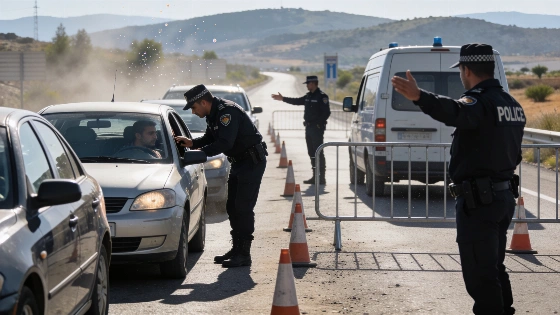
On Friday, police and gendarmes were stationed at every roundabout, road, and path leading north from Tangier to Fnideq (Castillejos), stopping vehicles and questioning drivers, especially those appearing under 50. The focus is clear: young people are being prevented from approaching the border, as authorities respond to new calls on social media for another mass crossing attempt.
Along the beaches and roads near Ceuta, the presence of security forces is now constant. Officers stand guard every 50 meters, and the only open crossing, El Tarajal, is heavily fortified. The area is filled with riot police vans, water cannons, military vehicles, ambulances, and even helicopters. The Royal Navy patrols the coastline, reinforcing the message that unauthorized entry will not be tolerated.
Travelers who cannot prove a legal reason to cross are turned back. The Moroccan Ministry of Interior has warned that all necessary measures will be taken to prevent further illegal crossings, especially ahead of Spain’s August 15 holiday, which has been cited in online calls for renewed attempts. Border fences have been reinforced with razor wire, and police in both uniform and plain clothes monitor all routes heading north.
Few people now attempt the journey. The beaches that recently saw thousands of migrants are nearly empty, with only a handful of Moroccans and sub-Saharan Africans visible. Those caught near the border without documents are placed on buses and sent hundreds of kilometers south, a practice known as “administrative removal.” Humanitarian groups report that at least 141 people have died trying to cross at El Tarajal in recent years.
In the industrial zones near the border, buses stand ready to transport anyone detained by security forces. Two weeks ago, up to 80,000 people surged toward Ceuta in just 36 hours, according to Spanish government estimates. Around 8,000 remain in the enclave, with about 5,000 potentially eligible to stay, including 2,500 minors and asylum seekers. The current crackdown is a stark contrast to June 2021, when over 10,000 people entered Ceuta with little resistance from Moroccan authorities.
Morocco’s strict response now includes public reminders that inciting irregular migration is punishable by law. The border at Benzú remains closed, and the fences at El Tarajal extend into the sea to block swimmers at low tide. Only those with proper documentation are allowed through the first checkpoint outside Castillejos, and the economic zones built after the pandemic now serve as holding areas for migrants before removal.
Ceuta’s border has long been a flashpoint in Spain-Morocco relations. The recent events highlight the ongoing challenges of managing migration flows at the EU’s southern frontier. The reinforced controls and rapid deployment of security forces reflect Morocco’s determination to prevent another crisis, at least for now. The situation remains tense, with authorities closely monitoring both physical routes and online activity for signs of renewed attempts.
Ceuta, together with Melilla, forms one of the European Union’s only land borders with Africa. These enclaves have historically attracted migrants seeking entry into Europe, often risking dangerous journeys by land or sea. The Spanish and Moroccan governments have periodically clashed over border management, but recent cooperation has led to tighter controls. The use of concertina wire, once removed from Spanish fences, now marks the Moroccan side, underscoring the shift in enforcement. The events of July 2024 serve as a reminder of the volatility at this border and the complex dynamics shaping migration in the region.