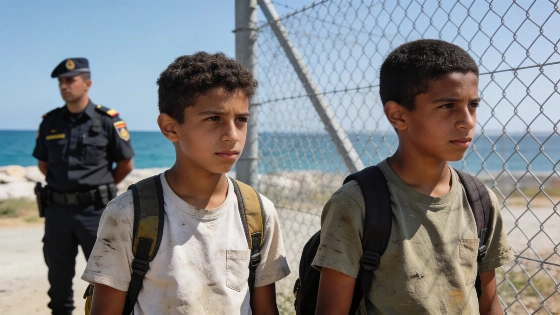
Morocco is open to accepting unaccompanied minors born in its territory who are currently in Spain. Rabat insists, however, that Spain must first remove legal and administrative hurdles. The issue follows a surge in border crossings.
Morocco has confirmed its willingness to take back unaccompanied minors born in the country who are now in Spain, but only if Spanish authorities address the legal and administrative barriers that currently prevent their return. This position comes in the wake of a major migration episode, when over 70,000 people—including thousands of minors—crossed into Ceuta, sparking a humanitarian crisis in the Spanish enclave.
According to diplomatic sources cited by EFE, Morocco’s stance is clear: the country is prepared to cooperate on the repatriation of these minors, provided Spain lifts the judicial and bureaucratic obstacles that have stalled the process. The Moroccan government, under the direction of Mohammed VI, has issued instructions to work towards the return of unaccompanied minors to their country of origin. Officials in Rabat emphasize that Morocco has consistently honored its commitments on this issue and remains open to dialogue at the highest level.
Spanish media and political actors have been criticized by Moroccan representatives for framing the situation as a breach of commitment by Morocco. Instead, Rabat points to Spanish administrative and, at times, judicial measures as the main impediments to the minors’ return. The diplomatic source also highlights that Spanish legislation currently complicates the process, making it difficult to implement family reunification or repatriation, even when the minors maintain contact with relatives in Morocco.
Under a bilateral agreement signed in 2007, Spain can request Morocco to take responsibility for unaccompanied minors born in the North African country. Each case must be individually assessed to determine the feasibility of family reunification. The proximity between the two countries and the ongoing ties many minors have with their families in Morocco theoretically make such reunification more straightforward, but in practice, legal hurdles remain significant.
The issue of unaccompanied minors has become a recurring point of tension in Spanish-Moroccan relations, especially following the mass entry into Ceuta. As reported in a related analysis, the crisis has been further complicated by judicial decisions in Spain that have affected border management and the handling of irregular migration flows. For more on the broader context of the Ceuta crisis and Morocco’s response to Spanish legal rulings, see this detailed report on the diplomatic standoff.
In recent years, the management of unaccompanied minors has posed logistical, legal, and humanitarian challenges for both countries. Spanish regions, particularly those bordering Morocco, have faced pressure on social services and accommodation facilities. The debate over the return of minors is not only a matter of bilateral relations but also touches on broader questions of child protection, migration policy, and international cooperation. As the situation evolves, any change in the legal framework or administrative procedures in Spain could have immediate consequences for hundreds of minors and their families on both sides of the Mediterranean.