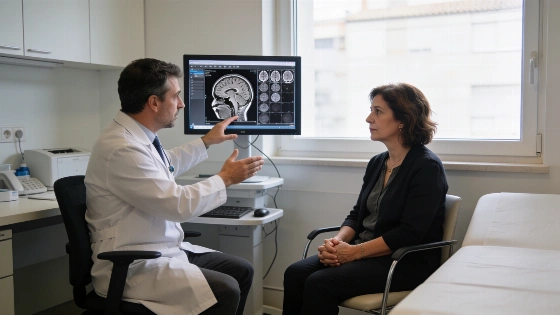
Spanish researchers are testing new immunotherapy approaches for multiple sclerosis, a disease that can advance quietly in the brain. Early detection and treatment remain critical as patients and doctors face uncertainty over how therapies will evolve.
New immunotherapy approaches, including CAR-T cell therapy now being tested for multiple sclerosis, target nerve damage that can progress silently in the brain. Researchers at the CaixaResearch Institute in Barcelona are also studying galectins, proteins that help regulate inflammation, in an effort to protect nerve cells and slow the disease.
The institute’s team, led by immunologist Gabriel Rabinovich, is exploring ways to improve these natural controls. The CaixaResearch Institute says it is the first center in Spain dedicated specifically to immunology.
More than 55,000 people in Spain live with multiple sclerosis, and about 1,900 new cases are diagnosed each year; nearly 70% of patients are women, information from the la Caixa Foundation.
Current treatments can reduce flare-ups, but they often do not stop the gradual loss of neurons that leads to the most disabling forms of the disease. Ana Zabalza, a neurologist at CEMCAT, says many patients notice subtle changes, such as slower movement and trouble concentrating, long before a major relapse. Constant fatigue is another common symptom. These shifts are easy to overlook, but they accumulate over time.
Núria García has experienced this progression. Her first symptoms in 2017, a numb thumb and weakness, were dismissed after initial scans. She also had involuntary hand movements. A second review revealed extensive brain lesions and led to a diagnosis. Standard treatments and corticosteroids kept her stable for years, but gradually she found she could no longer run or focus as before. The disease had shifted from relapsing-remitting to a progressive form, with damage accumulating quietly.
Spain sees about 1,900 new cases of multiple sclerosis each year, mostly among women between 20 and 40. Despite advances in treatment, old stereotypes persist. Many still assume the disease always leads to a wheelchair, but with proper care, most patients can live normally for years. CEMCAT brings together neurology and physiotherapy, with psychology and rehabilitation support for patients at every stage, including between flare-ups. The la Caixa Foundation identifies hidden inflammation and nerve damage that can continue even when relapses are under control as the basic clinical challenge. This points to the need for treatments that address more than visible symptoms.
Medscape summarized recent independent research in September 2026 showing that modern therapies can reduce relapses and lesion activity without necessarily producing impressive improvements in disability progression. B-cell-depleting therapies, for example, lowered relapse rates and T2 lesion volume, but showed no impressive difference in disability scores or nerve damage markers over two years.
The most promising new treatments may come from cancer research. CAR-T cell therapy, already used for some lymphomas, is now being tested for multiple sclerosis. The approach removes a patient’s immune cells for genetic modification, then returns them to the body to target specific inflammation. Unlike most drugs, CAR-T cells can cross the blood-brain barrier, potentially allowing treatment directly inside the brain.
Early trials are underway, but questions remain about long-term safety and how long the effects last. Cost is another concern. The CaixaResearch Institute aims to turn advances in immunology into real options for patients beyond laboratory results. For people living with multiple sclerosis, new treatments offer hope, but uncertainty remains.
Fatigue and cognitive changes are among the invisible symptoms that disrupt daily life for most patients. Mood swings can also interfere. Zabalza stresses the importance of trust and shared decisions between doctors and patients. Núria, now 51, says meeting others with the same diagnosis has helped her cope. She finds comfort in knowing she is not alone, even as the future remains uncertain.
There is still no cure for multiple sclerosis, but treatment has changed considerably in recent decades. Thirty years ago, effective therapies were rare. Spanish specialists now have access to many options, though stopping disease progression remains a challenge. Research into galectins, CAR-T and other approaches continues to seek ways to address the silent, ongoing damage in the brain.
Across Spanish healthcare, efforts are underway to promote earlier diagnosis and more personalized treatment as the system adapts to new pressures. The pharmaceutical sector faces rising costs and international policy changes, as noted in recent analysis. For patients like Núria, the stakes are immediate: new treatments need to reach those who need them. Spain’s model combines research and integrated care, with patient support, while access and continued investment remain impressive.