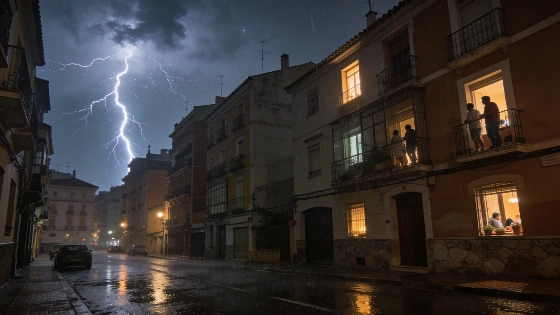
A severe thunderstorm swept across Málaga province in the early hours of 15 August 2026, bringing lightning and rain. The storm was visible from multiple districts of the city and nearby towns. Videos and photos shared online showed repeated flashes across the sky, with electrical activity peaking around 4 a.m.
Residents described the spectacle as unusually intense for August, and the account Málaga ayer y hoy was among those documenting the flashes. The same date also brought a magnitude-4.8 earthquake in the Granada metropolitan area, with its epicentre in Alhendín, information from seismic information attributed to Spain’s Instituto Geográfico Nacional (IGN). The storm and earthquake were separate events; their timing alone does not establish a connection.
Authorities had warned of possible showers and storms across eastern Andalusia. Rain was reported in several areas of Málaga, and residents in the city and outlying municipalities shared images and accounts of the overnight conditions. Thunder and lightning broke the usual summer calm.
Weather services continued to monitor conditions, with forecasts suggesting further showers and storms could develop. The lightning images from Málaga drew comparisons with other recent extreme-weather events in Spain. For example, recent storms in northern and eastern Spain also brought heavy rain and orange alerts.
The Granada seismic sequence continued after the stormy night. A second magnitude-4.8 earthquake struck near Gójar on 18 August, and by October reports described thousands of tremors across the metropolitan area. On 18 October, earthquakes of magnitude 1.9 and 2.8 were recorded in Vegas del Genil and Cájar; the stronger event occurred at about 08:41, roughly three minutes after the smaller tremor. These later earthquakes formed part of the Granada sequence and were distinct from the Málaga weather event.
Authorities advise residents to exercise caution during intense storms, particularly in exposed areas, and to follow official weather advisories. Summer storms are not unusual in southern Spain, where shifts in atmospheric conditions can bring sudden changes during the hot, typically dry season. The Málaga storm and the separate seismic activity in Granada made for an unsettled night across the region. Together, the events reinforced the importance of preparing for changing conditions.