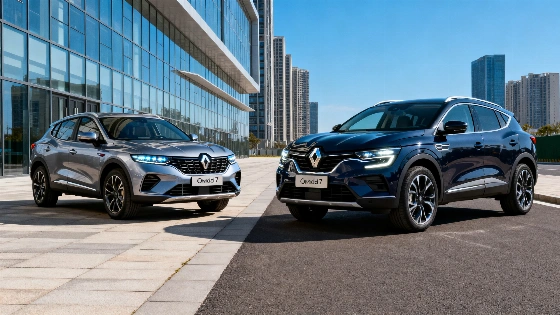
Omoda 7 and Renault Austral both target buyers seeking a well-equipped hybrid SUV at a competitive price. We break down their dimensions, engines, features, and value to help you decide which model fits your needs best.
Buyers looking for a hybrid SUV with strong equipment and a price just above €30,000 now face a compelling choice between the newly launched Omoda 7 and the updated Renault Austral. Both models promise advanced technology and practical features, but their approaches to hybrid power and everyday usability differ in key ways.
Size and Space
The Omoda 7, a recent arrival from China, positions itself above the Omoda 5 in the brand’s lineup. It measures 4,660 mm in length, 1,875 mm in width, and 1,670 mm in height, with a 2,720 mm wheelbase. This makes it noticeably larger than the Renault Austral, which, after a significant restyling last year, comes in at 4,533 mm long, 1,830 mm wide, and 1,618 mm high, with a 2,667 mm wheelbase. The Omoda 7’s extra size translates to a more imposing presence on the road and potentially more interior space for passengers.
Boot Capacity
Despite its larger exterior, the Omoda 7 offers a boot capacity of 537 litres, expanding to 1,294 litres with the rear seats folded. The Renault Austral, however, outperforms here: its standard hybrid version provides 673 litres with all seats up, or 657 litres in the full hybrid variant. With the rear seats down, the Austral’s capacity rises to 1,761 and 1,736 litres, respectively. For families or those who regularly carry large loads, the Renault’s advantage in cargo space is clear.
Engines and Hybrid Technology
The Omoda 7 keeps things simple with a single plug-in hybrid (PHEV) powertrain. It pairs a 1.5-litre petrol engine with a 150 kW electric motor, delivering a combined 279 hp. Its 18.4 kWh lithium-ion battery allows for up to 92 km of electric-only driving, and the model carries Spain’s Zero Emissions environmental label. Power is sent to the front wheels via an automatic transmission.
Renault Austral offers two hybrid options. The entry-level is a 1.3-litre mild hybrid (MHEV) petrol engine with 150 hp and an ECO label. The more advanced full hybrid (HEV) combines a 1.2-litre petrol engine with two electric motors for a total of 200 hp. Both versions use automatic transmissions and front-wheel drive. The Austral’s hybrids do not require external charging, making them more convenient for drivers without easy access to charging points, but they offer less electric-only range than the Omoda 7.
Standard Equipment
In terms of features, the Omoda 7 Pure trim is generously equipped. Highlights include a 19-inch wheel set, rearview camera, parking sensors, adaptive cruise control, lane keeping and blind spot assist, heated seats and steering wheel, bi-zone climate control, remote engine and climate start, tinted windows, digital instrument cluster (8.9 inches), a large 15.6-inch touchscreen, wireless updates, voice control, and wireless device charging. The list of driver assistance systems is extensive, covering emergency braking, cross-traffic alert, and more.
The Renault Austral Evolution trim also comes well equipped, with LED headlights, adaptive cruise control, rear camera, lane departure warning and prevention, fatigue detection, automatic emergency braking with pedestrian and cyclist detection, rain and light sensors, automatic parking brake, electric and heated mirrors, tinted windows, a 9-inch touchscreen multimedia system, digital instrument cluster, and dual-zone climate control. While both models offer strong technology packages, the Omoda 7 stands out for its larger screens and broader suite of driver aids in the base version.
Pricing
The Omoda 7 starts at €40,900 in Spain for the Pure trim, but with official brand discounts and the Plan Auto+ incentive, the price drops to €32,990. The Renault Austral begins at €33,300 for the Evolution trim with the mild hybrid engine. Opting for the full hybrid with 200 hp raises the price to €36,900. The price gap between the entry-level versions is minimal—just €310 in favor of the Omoda 7, provided buyers can access all available discounts and incentives.
Key Differences
While the Omoda 7 is larger in every exterior dimension, this does not translate into a bigger boot—Renault Austral leads in cargo space by a significant margin. Mechanically, the Omoda 7’s plug-in hybrid system offers more power and a much longer electric-only range, along with the Zero Emissions label, which may be important for urban driving and future regulations. The Austral, meanwhile, provides more traditional hybrid options that do not require charging, which could be a deciding factor for some buyers.
Both SUVs are well equipped in their base trims, but the Omoda 7 edges ahead in terms of driver assistance and infotainment features. Price-wise, the two are nearly identical when discounts are applied, making the choice largely dependent on individual priorities: electric range and tech for the Omoda 7, or boot space and hybrid convenience for the Renault Austral.
For buyers in Spain, the decision between these two models will likely come down to daily driving habits, access to charging, and the importance of cargo space versus electric autonomy. As hybrid technology continues to evolve, both the Omoda 7 and Renault Austral represent strong value in a competitive segment.