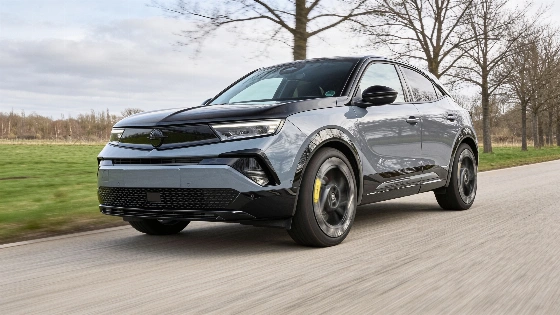
Opel’s Mokka GSE stands apart from the usual compact SUV. Its electric motor produces 207 kW (281 PS) and 345 Nm of torque, while a chassis tuned for excitement delivers a level of driving engagement rarely found in its segment. The GSE badge, once reserved for Opel’s most spirited petrol cars, now marks the brand’s top electric offering, with sharp styling and genuine performance credentials. Its development is linked to the Mokka GSE Rally competition car, giving the road-going model a performance identity beyond a simple power upgrade.
At 4.15 meters long, the Mokka GSE is compact enough for urban life but packs a punch that’s hard to ignore. Its single-speed transmission and front-wheel-lead setup deliver brisk acceleration and confident handling, especially in tight corners. Opel quotes 0-100 km/h in 5.9 seconds and a top speed of 200 km/h, making it the quickest series-production electric Opel to date. That performance comes at a price: the GSE starts at nearly €50,000, positioning it as a premium choice in the small electric SUV market. The reported Austrian starting price is €47,090, a market-specific figure rather than a universal price.
Equipment and Comfort
Opel has equipped the Mokka GSE generously. Standard features include a reversing camera and keyless entry. Adaptive cruise control and advanced matrix LED headlights, which intelligently manage light distribution, are also included. The infotainment system offers smartphone integration and Wi-Fi connectivity. Drivers can charge wirelessly via the "myOpel" app, staying connected on the go.
Despite these strengths, the navigation system, powered by TomTom, feels limited. The absence of a large digital map in the instrument cluster and augmented reality directions are noticeable omissions. Voice control is also inconsistent, often requiring repeated commands and failing to access all vehicle functions smoothly.
Interior and Practicality
The Mokka GSE’s sports seats, with integrated headrests and mechanical adjustment, balance comfort with support. Their plush upholstery and strong lateral grip make spirited driving enjoyable, though the elevated driving position and distant steering wheel may not suit everyone. Rear-seat space is tight, with limited legroom and awkward access. The cabin feels less spacious than some rivals.
Cargo capacity is modest, ranging from 310 to 1,060 liters, and the GSE cannot be fitted with a tow hitch. It comes with exclusive 20-inch alloy wheels and Michelin Pilot Sport EV tires, specifically tuned for the car’s weight and dynamics. The suspension features shorter springs and a stiffer setup, while larger brakes with distinctive yellow calipers underline its sporting intent. Published specifications include 380 mm front brakes with four-piston Alcon calipers and 268 mm rear brakes. The model measures 4,150 mm long and 1,506 mm high, retaining a compact footprint despite its performance-focused hardware.
On the Road
The Mokka GSE comes into its own on twisty roads. The car feels agile and planted, with its 345 Nm of torque delivered smoothly to the front wheels. Even under hard acceleration, torque steer is well controlled, thanks in part to the mechanical Torsen limited-slip differential, which helps manage torque delivery and improve traction. The suspension is firm but not punishing, absorbing bumps without excessive harshness or noise. Direct steering makes every corner an invitation to push harder.
Acceleration is brisk and linear, easily surpassing 160 km/h, and the brakes are up to the task, stopping the car from 100 km/h in just over 32 meters. The electric motor’s subtle whine adds to the sense of urgency. The car also launches out of tight bends with confidence, setting it apart from more sedate competitors. For those comparing options in the compact electric crossover space, the Mokka GSE’s dynamic character stands out, much like the Skoda Epiq and Renault 4, which were recently compared for their urban versatility in this analysis of city-focused EVs.
Range and Charging
The basic compromise with the Mokka GSE is its range. In real-world conditions, energy consumption averaged 23.7 kWh per 100 kilometers, translating to a practical range of around 260 kilometers, well below Opel’s official WLTP figure of up to 336 kilometers. That WLTP figure is a test-cycle maximum, not a guaranteed real-world distance. The car’s 54 kWh battery has approximately 51 kWh usable capacity. It supports AC charging at up to 11 kW and DC fast charging at up to 100 kW; a 20% to 80% top-up takes about 27 minutes. The lack of strong regenerative braking and true one-pedal driving limits efficiency gains in stop-and-go traffic.
Final Thoughts
The Opel Mokka GSE combines compact dimensions with bold design and genuine driving excitement. Its equipment and safety features are competitive, though not class-leading, and its electric range may disappoint those seeking long-distance flexibility. For drivers who prioritize agile handling and a sense of fun behind the wheel, the Mokka GSE makes a strong case. As electric SUVs continue to evolve, models like this show that performance and personality need not be sacrificed for efficiency.
The Mokka GSE’s pricing and positioning reflect a broader trend in the European market, where compact electric crossovers increasingly target drivers who want more than practicality. Its focus on driving dynamics and design sets it apart, but buyers should weigh its limited range against the premium price and their daily needs.