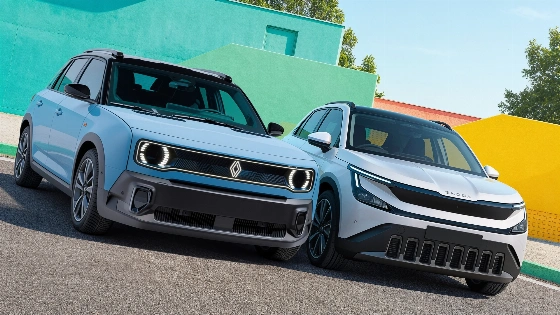
The Skoda Epiq and Renault 4 E-Tech both promise practical electric mobility for four adults in the city. We compare their space, performance, range and pricing to see which model stands out for urban drivers.
Skoda has launched its most compact electric model yet, the Skoda Epiq, directly challenging the Renault 4 E-Tech in Spain’s growing market for affordable city EVs. Both vehicles are designed to comfortably seat four adults and offer a practical alternative for urban mobility, but their differences in space, performance and price are hard to ignore.
Dimensions and Interior Space
The Skoda Epiq measures 4.17 meters in length, 1.80 meters in width and 1.58 meters in height, with a 2.60-meter wheelbase. Its interior is notably spacious for the segment, edging out the Renault 4 E-Tech in both passenger comfort and cargo capacity. The Epiq’s boot offers a generous 475 liters, including a 25-liter underfloor compartment—well above the Renault’s 375 liters (VDA standard).
Renault’s 4 E-Tech is slightly shorter at 4.14 meters long and 1.57 meters high, but with a marginally longer wheelbase of 2.62 meters. While four adults up to 1.85 meters tall can travel comfortably, the rear space and trunk volume fall short of the Skoda. The Renault’s interior, though well-assembled, relies heavily on recycled plastics and textiles, giving a solid but less premium feel.
Technology and Design
Inside, the Skoda Epiq features a minimalist dashboard with two digital displays: a 13-inch central touchscreen for infotainment and a 5.3-inch instrument cluster. Skoda emphasizes the use of durable, sustainable materials throughout the cabin. The exterior follows the brand’s Modern Solid design language, with sharp LED lighting and a restrained, contemporary look.
The Renault 4 E-Tech’s dashboard is dominated by a 10-inch multimedia screen running Android Automotive, offering wireless Android Auto and Apple CarPlay, Google Maps integration, and route planning that factors in battery status and charging points. The digital instrument panel varies between 7 and 10 inches depending on trim. Renault’s approach is functional, but the materials and finish are less refined than the Skoda’s.
Performance and Range
Currently, the Skoda Epiq is available in its most powerful configuration: the Epiq 55, with a 211 hp motor and a 51.7 kWh net (55 kWh gross) NCM battery, delivering up to 440 km of range. Fast charging is supported up to 133 kW, allowing a 10–80% charge in just 24 minutes. Two more affordable versions are expected soon: the Epiq 35 (116 hp, 37 kWh LFP battery, 310 km range) and Epiq 40 (135 hp, same battery, 310 km range), with lower charging speeds. All Epiq models include V2L, V2H and V2G functions for bidirectional charging.
The Renault 4 E-Tech offers two powertrains: a 120 hp version with a 40 kWh battery (308 km range) and a 150 hp version with a 52 kWh battery (408 km range). Charging is capped at 11 kW AC, with DC fast charging up to 80 kW (40 kWh battery) or 100 kW (52 kWh battery), reaching 80% in about 30 minutes. Renault also provides V2L capability, allowing the car to power external devices up to 3.7 kW.
Pricing and Equipment
Price is a decisive factor. The Skoda Epiq starts at €33,650, but with brand discounts, Spain’s Plan Auto+ and the CAE, the effective price drops to €26,175. Equipment levels include Urban, Selection and a First Edition launch model, with optional packages for convenience, technology and travel.
The Renault 4 E-Tech starts at €27,954 (including discounts and CAE), positioning it slightly above the Epiq after incentives. Trim levels—evolution, techno, techno ‘plein sud’, iconic and iconic ‘plein sud’—offer varying features, but all include 18-inch wheels, digital instruments, and a suite of driver assistance systems. The base evolution trim is only available with the 120 hp powertrain.
Which Model Wins?
For city drivers seeking maximum space, range and value, the Skoda Epiq stands out. It offers more power, greater autonomy, a larger and more versatile interior, and a lower effective price than the Renault 4 E-Tech. The Epiq’s upcoming entry-level versions are set to make it even more accessible.
The Renault 4 E-Tech, meanwhile, appeals to those drawn by nostalgia and the charm of a modern reinterpretation of a classic. Its design and tech features are competitive, but it lags behind the Skoda in practicality and price-performance ratio. For buyers who prioritize emotional connection over outright utility, the Renault remains a compelling choice.
It’s worth noting that the competition among compact electric cars is intensifying, with new models and technologies arriving rapidly. As seen with Ferrari’s recent move into the electric segment—highlighted by the auction of its first all-electric Luce at Monterey (Ferrari’s debut EV auction)—the landscape for electric mobility in Europe is evolving fast, and consumer expectations are rising accordingly.
In summary, the Skoda Epiq currently sets the benchmark for affordable, spacious city EVs in Spain, while the Renault 4 E-Tech offers a stylish, heritage-inspired alternative for those willing to trade some practicality for personality.