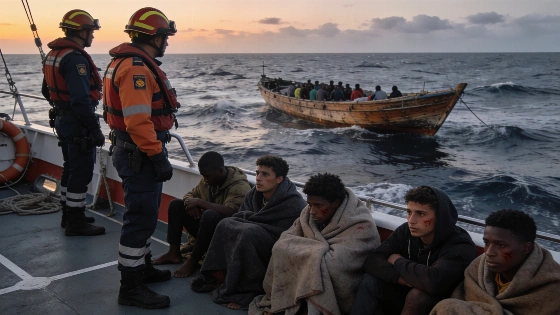
A migrant boat drifting south of the Canary Islands was found with 45 survivors and eight bodies. More than 80 people, including a baby, are dead or missing after 27 days at sea. Spanish rescue services responded overnight.
Spanish maritime authorities have confirmed a major loss of life after intercepting a migrant boat drifting 120 kilometers south of the Canary Islands. The vessel left Gambia nearly a month ago with 128 people on board. When rescue teams arrived, they found 45 survivors and eight bodies, including a baby. More than 80 others are missing and presumed dead at sea.
The case highlights the deadly risks migrants face on the Atlantic crossing to Spain. The boat had been at sea for 27 days, with food and water running out and conditions worsening. Salvamento Marítimo said the rescue began after an aerial patrol spotted the drifting cayuco on Wednesday afternoon. The Guardamar Urania rescue ship reached the boat at midnight, but rough seas made it impossible to recover five of the bodies safely, so they remained on board.
According to Caminando Fronteras, at least 635 people died on the Atlantic route to the Canary Islands in the first five months of 2026, making it one of the deadliest migration corridors in Europe.
This tragedy comes as Spain faces a rise in irregular migration, especially along the Canary route. Local authorities and aid groups warn that the Atlantic passage is among the most dangerous for migrants. Caminando Fronteras, an NGO that tracks migrant journeys, confirmed the scale of the disaster and called for a coordinated response. The Irish Times, citing Caminando Fronteras and the International Organization for Migration (IOM), reported that similar incidents on this route have led to high death tolls, with some boats carrying around 200 people and only a few dozen surviving.
While the immediate focus is on the rescue, the broader situation is hard to ignore. The incident comes as tensions rise in Ceuta, where recent unrest has drawn national attention to Spain’s border management. As reported earlier, protests and clashes have broken out in Ceuta over the presence of migrants, showing the political and social strain migration puts on Spanish enclaves.
Official figures from Spanish authorities show that arrivals via the Canary Islands have increased in recent years, driven by instability and poverty in West Africa. The journey, often made in overcrowded and unsafe boats, frequently ends in tragedy. Maritime rescue teams are stretched thin, and the lack of safe, legal routes leaves migrants with few options but to risk the crossing.
Since 2022, 376 boats have disappeared on sea routes to Spain, with all those on board considered missing, according to Caminando Fronteras. Humanitarian organizations such as Médecins Sans Frontières have reported that survivors often arrive with acute psychological stress, hypothermia, and severe trauma.
Spain’s response to these disasters is under growing scrutiny. The inability to recover all the bodies because of rough seas shows the limits of rescue operations, while the scale of loss on a single boat points to the shortcomings of current policies. This incident is not isolated but part of a pattern. Without changes to migration policy and more international cooperation, the Atlantic will continue to claim lives, and Spain will remain at the center of a crisis that is far from over.