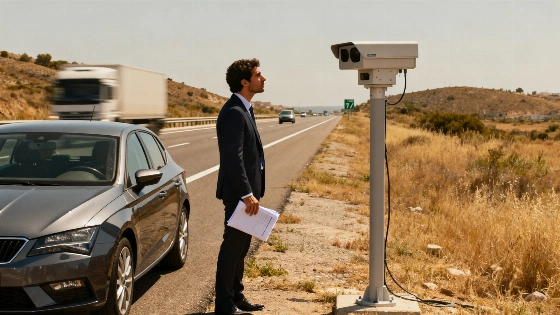
Pere Navarro, head of Spain’s traffic authority, insists that losing a driving license impacts everyone equally—unlike fines, which hit drivers differently depending on income. He calls the points-based system essential for road safety.
When Pere Navarro, director of the Dirección General de Tráfico (DGT), speaks about road safety, his words carry weight. In a recent public appearance, Navarro made it clear: while monetary fines for traffic violations may sting for some and mean little to others, the suspension of a driving license is a penalty that cuts across all social and economic lines.
Navarro’s argument is rooted in a simple observation. Financial penalties, he explained, are inherently unequal. For a family with modest means, a hefty fine can be a serious setback. For a wealthy driver, the same amount is little more than an inconvenience. This disparity, Navarro believes, undermines the effectiveness of fines as a deterrent.
The Case for Points
That’s where Spain’s points-based driving license system comes in. Introduced as a major reform in Spanish road safety policy, the system deducts points for serious infractions. When a driver’s points run out, their license is suspended—regardless of their bank balance. According to Navarro, this is the only truly democratic sanction: “Time and the freedom to drive can’t be bought.”
The points system was designed not just to punish, but to educate. Drivers who repeatedly break the rules are temporarily removed from the roads, sending a clear message that reckless behavior has real consequences. Navarro sees this as a way to reinforce fairness and public trust, ensuring that road safety is not a privilege reserved for those who can afford to pay their way out of trouble.
Adapting to New Risks
Navarro also acknowledged that the challenges facing road safety are constantly evolving. The widespread use of smartphones and messaging apps behind the wheel has forced the DGT to toughen penalties for distracted driving, including steeper point deductions for these offenses. The system, he said, must adapt to new risks if it is to remain effective.
There is ongoing debate in Europe about whether fines should be adjusted according to income, as is already the case in some northern countries. In these systems, penalties are calculated based on the offender’s daily earnings, making them more proportionate. However, Navarro indicated that, for now, Spain’s focus remains on refining the points system and expanding educational courses that help drivers regain lost points through improved awareness and safer habits.
Beyond Punishment
For Navarro, the ultimate goal is not just to penalize, but to change attitudes. He wants drivers to understand that a car is not a private space exempt from the law, but a shared environment where every action can affect others. The effectiveness of road safety policy, he argued, should be measured not by the amount of money collected in fines, but by its ability to change dangerous habits for good.
Spain’s points-based license system has been credited with reducing road fatalities since its introduction, though the DGT continues to monitor and update its approach as new challenges emerge. The debate over income-based fines may continue, but for now, Navarro’s message is clear: when it comes to keeping the roads safe, the loss of driving privileges remains the most powerful—and equal—deterrent.