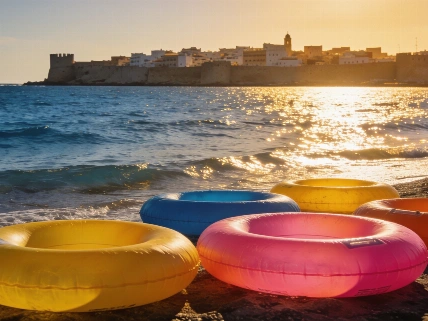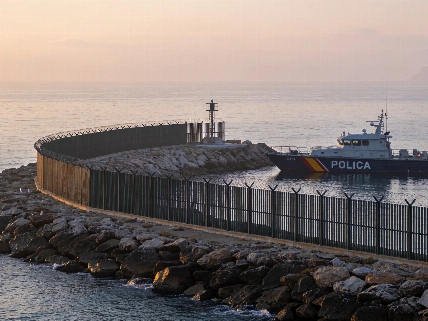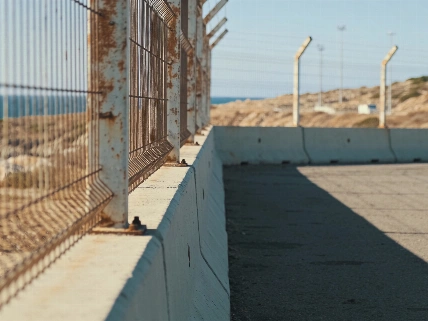
One migrant interviewed after crossing said a soldier near the shore sold flotation rings to her and her friends for 270 dirhams, about €27. That account appears in a Policía Nacional report on the mass arrival at Ceuta’s Tarajal beach on 30-31 July 2026, when people crossed from Morocco into Spain’s North African enclave.
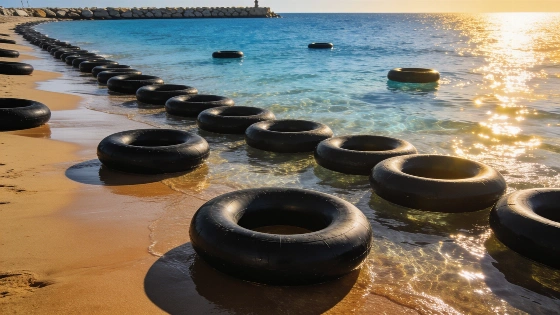
According to the report, seen by RTVE, the Centro Nacional de Inmigración y Fronteras (CENIF) estimates an intermediate scenario of 8,000 to 10,000 plastic rings. TodoAlicante identified the matching product as the Intex Giant Tyre, a novelty swim ring designed to resemble a vehicle tire. The rings were predominantly black and visually similar. Police say their scale and uniformity point to advance organisation.
The analysis reportedly considered different visual-estimation methods: one count produced about 3,000 to 4,000 visible rings, while another extrapolation reached 30,000 to 40,000. Investigators settled on the intermediate estimate of 8,000 to 10,000. Aerial and close-up images from different parts of the Tarajal border area informed the analysis.
Investigators consider it unlikely that migrants bought the rings directly from shops or online. The report says retailers would not have had enough stock to meet unexpected demand for thousands in a single day without prior planning and orders. Police also consider it unlikely that the rings were brought from outside Castillejos. They conclude that one large batch was acquired beforehand for distribution at specific locations, where the rings were then used widely.
Interviews cited in the report offer differing accounts of where people obtained the rings: some said they bought them in Castillejos, while others said they bought them on the beach before entering the breakwater. Reports describe arrivals in successive waves, with some people equipped with wetsuits and flippers, as well as flotation devices, before families followed; women and children were among them. One account put the number of entrants at approximately 72,000.
The police analysis was submitted to a judicial inquiry into the 30-31 July crossing. Magistrate Tardón described a mobilisation in successive waves, while reporting also noted that Spain’s intelligence service, the CNI, did not share the National Police’s assessment that the episode was meticulously coordinated. Claims that Moroccan authorities orchestrated the crossing remain allegations, not a final judicial finding.
The report focuses on the suspected supply and distribution at Tarajal. RUSSPAIN has also covered a separate issue around arrivals in the Canaries.