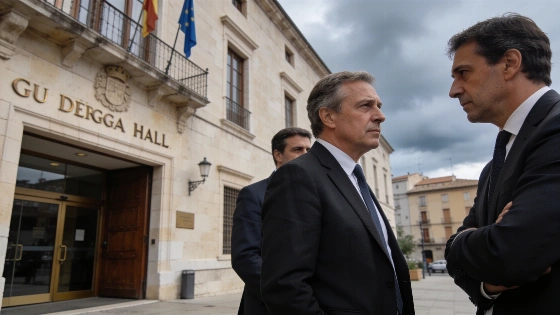
Girona faces a turbulent run-up to municipal elections after a key coalition collapsed. The mayor’s new pact with PSC and the resignation of ERC’s candidate have left the city’s future leadership in doubt.
Girona’s political landscape has entered a period of deep uncertainty just months before the next municipal elections. The city, long considered a stronghold of Catalan independentism, now finds itself at the center of shifting alliances and leadership crises. The collapse of the governing coalition between Guanyem (CUP), Junts, and ERC has forced Mayor Lluc Salellas to seek new support, resulting in an unexpected agreement with the PSC. This move has not only altered the balance of power but also raised questions about the future direction of Girona’s city hall.
The breakdown came after Junts withdrew from the municipal government, citing repeated breaches of agreement. In response, Salellas negotiated a new municipal structure with the PSC, securing five key commitments in exchange for their support. These include preserving Parc Jordi Vilamitjana, building the Provincial Archive in Fontajau, safeguarding the Truffaut cinema, improving waste collection, and renovating Carrer de la Creu. The PSC, led by Sílvia Paneque, had previously won the 2023 elections but was sidelined by the independentist pact. Now, with the new arrangement, the socialists are back in a pivotal position, though Paneque’s own future as a candidate remains unclear.
The situation is further complicated by turmoil within ERC. The party’s mayoral candidate, Marc Puigtió, resigned after a leaked audio revealed him criticizing his own party. This internal conflict has left ERC without a clear leader and exposed deep divisions within its local ranks. According to Diari de Girona, Puigtió’s narrow primary victory and the sudden influx of new party members—many reportedly close to him—have only intensified the party’s instability.
Meanwhile, Junts faces its own challenges. After three years in government, the party, represented by former minister Gemma Geis, is distancing itself from the current administration’s record. Geis, who has not faced internal challenges to her leadership thanks to the backing of Carles Puigdemont, must now contend with criticism over the timing of Junts’ exit from the coalition and the party’s loss of control in Girona—a city previously led by Puigdemont and Marta Madrenas. The independentist bloc, which no longer governs any of Catalonia’s four provincial capitals, sees Girona as a crucial opportunity to regain influence.
The city’s administration has also suffered reputational damage from failed initiatives, such as the much-publicized but problematic rollout of smart waste containers. Additionally, some policy positions—like questioning the need for a homeless shelter—have sparked controversy given the socio-economic disparities between Girona’s neighborhoods, a situation the city shares with Badalona.
As the election approaches, several key questions remain unresolved: whether Paneque will leave her current government post to run for mayor, what role Puigdemont might play if amnestied, and whether the independentist alliance can be rebuilt. The uncertainty in Girona echoes the broader volatility seen in other Spanish cities, such as Seville, where coalition politics have previously reshaped local governance, as detailed in this analysis of Seville’s first democratic mayor.
Girona’s recent history has been marked by both international acclaim and local challenges. The city’s global profile, boosted by landmarks like the Cathedral and the Celler de Can Roca, contrasts with the current political instability. With nine months until the next vote, the outcome remains highly unpredictable, and the city’s leadership is more contested than at any point in recent memory.
For context, Girona is the capital of one of Catalonia’s four provinces and has often been a bellwether for regional political trends. The city’s shifting alliances and leadership struggles may signal broader changes in Catalan politics, especially as independentist parties seek to regain lost ground. The coming months will be critical in determining whether Girona remains under independentist control or if the PSC can capitalize on the current fragmentation to reclaim the mayoralty.