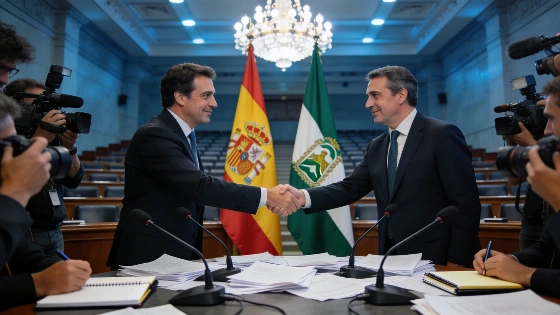
PP and Vox have finalized a coalition agreement in Andalusia, ensuring Juan Manuel Moreno's re-election as regional president. The deal includes a 'national priority' principle for public aid, echoing similar pacts in other regions.
PP and Vox have reached a formal coalition agreement in Andalusia, paving the way for Juan Manuel Moreno to secure the necessary majority for his re-election as president of the Junta. The pact, confirmed just before the decisive parliamentary vote, introduces the 'national priority' principle for access to public aid and services—a demand long championed by Vox and now accepted by the regional PP leadership under pressure from the party's national headquarters.
The agreement follows the template set by previous PP-Vox coalitions in Extremadura, Aragón, and Castilla y León, where similar measures have been implemented. In Andalusia, the new clause stipulates that all public subsidies and benefits will be guided by the principle of 'national priority,' favoring those with a proven, lasting, and verifiable connection to the region. This approach, often framed as 'arraigo,' effectively places Spanish nationals ahead of immigrants in the allocation of public resources.
Negotiations between the two parties centered on the extent of Vox's participation in the regional government. While the PP initially aimed to govern alone, it ultimately conceded to Vox's demand for representation in the cabinet, though the exact distribution of ministerial portfolios remains undisclosed. The Agriculture Ministry emerged as a key point of contention, with Vox seeking control, mirroring arrangements in other regions. The PP, however, resisted ceding authority over equality policies.
This coalition marks the fifth such government in Andalusia since the first regional elections in 1982. Previous alliances included the PSOE's partnerships with the Partido Andalucista and Izquierda Unida, as well as the PP's coalition with Ciudadanos after the 2018 elections. The current deal with Vox signals a significant shift, as the far-right party gains formal influence in the regional executive for the first time.
Moreno, who previously dismissed the 'national priority' concept as mere campaign rhetoric, has now incorporated it into official policy under direction from the PP's national leadership. The move comes after the PP fell just two seats short of an absolute majority in the Andalusian parliament, leaving Vox's 15 deputies as the decisive factor. With left-wing parties refusing to support a solo PP government, the coalition became the only viable path to securing Moreno's investiture.
In the previous legislature, Vox supported the PP-led government from outside the cabinet. This time, their direct involvement reflects a broader trend of right-wing coalitions reshaping regional politics across Spain. The inclusion of 'arraigo' criteria is not entirely new—some public benefits, such as dependency support, already require a minimum period of residence—but its expansion under the new agreement could have wider implications for access to services and subsidies.
For context, coalition governments have become increasingly common in Spain's autonomous communities, often resulting from fragmented parliaments and shifting political alliances. The rise of Vox as a kingmaker has altered the balance of power, compelling mainstream parties to negotiate on contentious issues like immigration and social policy. The Andalusian pact underscores the growing influence of these dynamics at the regional level.