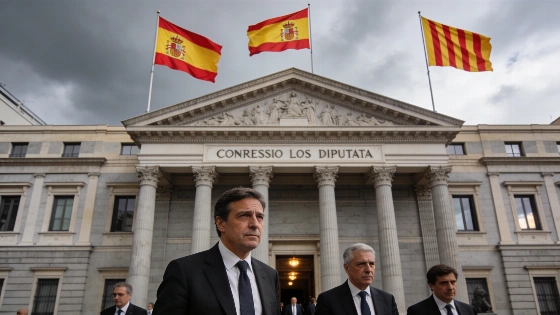
The Partido Popular demands the government suspend new citizenship grants under the 'ley de nietos'. The party challenges the legal basis for extending nationality to descendants of Spanish emigrants, citing electoral concerns.
The Partido Popular (PP) has intensified its campaign against the government's application of the so-called 'ley de nietos', demanding an immediate freeze on the process of granting Spanish nationality to descendants of emigrants. This move follows a recent decision by the Junta Electoral Central, which, while rejecting calls to suspend overseas voting, requested further clarification from the Instituto Nacional de Estadística regarding the registration of new citizens abroad. The PP argues that the government's current approach risks undermining the integrity of the electoral system and lacks proper parliamentary oversight.
At the heart of the dispute is a ministerial instruction issued in October 2022, which broadened the scope of the Ley de Memoria Democrática. Originally, the law was intended as a reparative measure for those whose families suffered exile for political or ideological reasons. However, the instruction extended eligibility to all descendants of Spaniards born abroad, including those whose ancestors left for economic reasons. The PP, led by Alberto Núñez Feijóo, has formally requested the annulment of this instruction, insisting that such a significant change should not be enacted without a full debate in Congress.
Despite agreeing in principle that all grandchildren of Spanish emigrants should be eligible for nationality, the PP maintains that the current process is flawed. The party contends that the ministerial instruction not only bypasses legislative scrutiny but also potentially expands eligibility to great-grandchildren, despite the text referring only to 'nietos' and 'hijos'. This, they argue, creates legal uncertainty and opens the door to inconsistencies in the application of the law.
The Junta Electoral Central's recent resolution did not support Vox's demand to suspend the overseas electoral roll, noting that the system has been in place since 2011 without major complaints. However, the electoral authority did call for a detailed report from the Oficina del Censo Electoral to clarify how new citizens under the 'ley de nietos' are assigned to specific municipalities for voting purposes. The JEC emphasized the need for clear, uniform criteria regarding documentation and the determination of electoral ties, a point the PP has seized upon to bolster its case against the government's handling of the issue.
Alma Ezcurra, the PP's Deputy Secretary for Sectoral Coordination, stated that the JEC's findings highlight significant doubts about the nationality granting process. She reiterated the party's demand for the government to suspend new registrations until transparent and consistent criteria are established. The PP's legal challenge mirrors a similar move by Vox, which submitted an identical request days earlier. The government now has three months to respond to these challenges, after which the matter could be considered rejected by default if no reply is given.
This dispute over the 'ley de nietos' comes amid broader tensions between Spain's main political parties regarding the management of electoral processes and the extension of citizenship rights. The debate echoes previous controversies, such as the PP's recent call for explanations from Interior Minister Fernando Grande-Marlaska over alleged political pressure on the Guardia Civil, as reported in a related investigation. These ongoing clashes reflect the heightened scrutiny of government actions in the run-up to future elections and the sensitivity surrounding changes to the electoral and citizenship landscape.
For context, the Ley de Memoria Democrática was enacted to address historical injustices suffered by those forced into exile during Spain's turbulent 20th century. The law's additional provisions for descendants were seen as a way to reconnect families with their Spanish heritage. However, the expansion of eligibility criteria has sparked debate over the balance between historical redress and the potential for unintended political consequences. The outcome of the PP and Vox challenges may set important precedents for how Spain manages its diaspora and the rights of future generations to claim Spanish nationality.