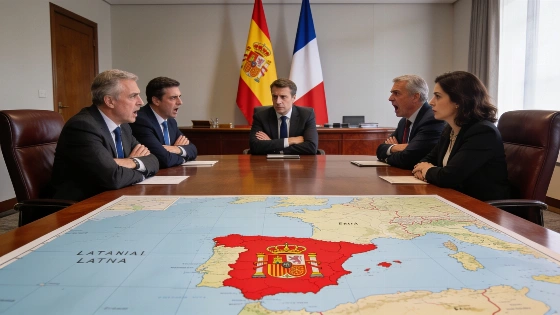
The PP's decision to block a key treaty with France and Rajoy's controversial comments have sparked diplomatic friction. The party now prioritizes alliances with Latin American conservatives, reshaping Spain's foreign policy.
The Partido Popular (PP) has intensified its diplomatic standoff with France after blocking the ratification of the bilateral Treaty of Friendship in the Spanish Senate. This move, combined with recent controversial remarks by former Prime Minister Mariano Rajoy about the French national football team, has triggered both internal unease within the PP and a strong reaction from the French government. The situation highlights a significant shift in the PP's foreign policy priorities, as the party increasingly seeks to build ties with conservative governments in Latin America.
Rajoy's comments, published in Marca, questioned the 'Frenchness' of players of African descent in the French squad, despite most being born in France. The statement, widely criticized as racist, drew immediate condemnation from French officials and discomfort among PP leaders. Party president Alberto Núñez Feijóo later described Rajoy's words as an attempt at humor that failed, acknowledging the internal discontent and the diplomatic fallout. According to party sources, the incident underscored the risks of leaving such remarks on record, with some senior figures admitting Rajoy's reputation had suffered.
The diplomatic row comes as the PP has chosen to block the Spain-France treaty, signed in Barcelona in January 2023 by Pedro Sánchez and Emmanuel Macron, citing concerns over provisions for ministerial participation in each other's cabinet meetings. While similar arrangements exist between France and other EU countries, the PP's decision is also seen as part of its broader opposition strategy against the Sánchez government. The move has left the treaty's entry into force suspended and further strained relations with Paris, especially as no French representatives attended the recent European People's Party (EPP) forum in Madrid.
Behind the scenes, the decision to reject the treaty has been attributed to Ildefonso Castro, the PP's secretary of International Policy and a former diplomat under Rajoy. Castro, known for his discreet profile, has not made public statements since his appointment by Feijóo. Within the EPP, the French Republicans—PP's traditional counterparts—are considered weakened by Macron's dominance, reducing the incentive for the Spanish party to prioritize ties with France.
Instead, the PP is redirecting its international efforts toward Latin America, aiming to position itself as a bridge between the European Union and the region's new wave of right-leaning governments. At the EPP forum in Madrid, Feijóo emphasized the importance of strengthening links with Ibero-American countries, describing the conservative shift in the region as a 'new political enlightenment.' He called on EPP leader Manfred Weber to make Latin America a priority for the EU, drawing parallels with the longstanding transatlantic relationship with the United States.
The PP's renewed focus on Latin America is partly driven by concerns over the growing influence of Vox, which has established a strong presence in the region through its Disenso foundation and financial resources. Feijóo's approach does not distinguish between traditional conservatives and far-right figures, as he extended gestures to leaders such as Argentina's Javier Milei and Colombia's Abelardo de la Espriella. The party also welcomed the return of Fujimorismo in Peru, with Keiko Fujimori participating remotely in the Madrid forum.
This strategic pivot serves both external and internal objectives for the PP. By cultivating relationships with Latin American conservatives, the party seeks to carve out its own international space and reinforce its position as a reference point for a transatlantic conservative bloc. The shift comes at a time when foreign policy has become another arena of confrontation with the Sánchez government.
Meanwhile, the PP has also criticized the provisional implementation of the EU-UK agreement on Gibraltar, labeling it a 'fraud' and accusing Sánchez of squandering Spain's negotiating leverage post-Brexit. The demolition of the Gibraltar border fence was welcomed by Andalusian president Juan Manuel Moreno, but Feijóo cautioned that the agreement must be completed to avoid weakening Spain's position. Despite these disputes, Feijóo has chosen to keep the spotlight on Latin America and the ongoing rift with France, signaling a period of uncertainty in the PP's foreign policy direction.
Spain's foreign policy traditionally emphasized close cooperation with France and active engagement within the EU. The current tensions mark a departure from this approach, reflecting both the PP's internal dynamics and the evolving landscape of international alliances. As the party navigates new partnerships in Latin America and manages diplomatic strains with key European neighbors, the practical implications for Spain's role in the region and its relations with longstanding partners remain to be seen.