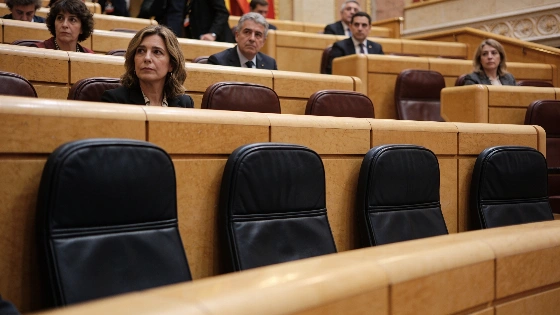
The Partido Popular is moving to censure five ministers for missing Senate sessions on Ceuta. The party is preparing a constitutional challenge that could reach Spain’s highest court. The government’s absence has led to a direct institutional standoff.
The Partido Popular (PP) has set off a direct confrontation with the government by formally challenging ministers who have repeatedly failed to appear in the Senate. The party’s move, announced ahead of the next plenary session, targets five ministers—Fernando Grande-Marlaska, Margarita Robles, José Manuel Albares, Mónica García, and Ana Redondo—over their handling of the Ceuta crisis and their refusal to attend Senate hearings.
The dispute centers on the PP’s claim that the government is deliberately avoiding parliamentary scrutiny in the Senate, where the opposition holds an absolute majority. PP spokesperson Alicia García called the empty ministerial seats a violation of constitutional duties, arguing that the government cannot decide when and where to answer to parliament. According to Democrata.es, García has described the government’s actions as a "total failure" and confirmed that the PP will seek formal censures of the ministers involved.
The PP had previously attempted to force urgent ministerial attendance through the Supreme Court, but the request was rejected as the court found no grounds for immediate intervention during the August parliamentary session.
The conflict escalated after the ministers for Interior, Defense, and Foreign Affairs chose to explain their actions in the Congress instead of the Senate, despite being summoned during the August crisis in Ceuta. The PP had earlier asked the Supreme Court to order the ministers to appear within 24 hours, but the court declined, ruling that immediate compliance was not required during the extraordinary August session, as reported by El País.
Now, the PP is invoking Article 110.1 of the Spanish Constitution and Article 66.2 of the Senate’s rules, both of which require government attendance when requested by either chamber. García stressed that this is a binding legal duty, not a matter of protocol. The party is preparing to take the issue to the Constitutional Court if the government continues to ignore Senate summonses. According to Democrata.es, the PP interprets these laws as obliging the government to appear before any chamber upon request, not just as a political courtesy.
Alongside the legal challenge, the PP is also seeking formal censures of the five ministers for their management of the Ceuta crisis. The party argues that the government’s absence, combined with Prime Minister Pedro Sánchez’s vacation in the Canary Islands during the crisis, shows what it calls "shame, mismanagement, and arrogance." Statements cited by PP.es claim that ministers delayed explanations in parliament for nearly a month and failed to provide "real figures" about the events in Ceuta.
The dispute is not only about the absence of ministers, but also centers on which parliamentary chamber should receive their explanations. The government preferred to postpone Senate appearances and later address the Congress, a move the PP sees as avoiding scrutiny in the chamber where the opposition holds an absolute majority.
El País
This standoff comes amid wider tensions over government transparency and parliamentary control. The PP’s strategy is to force the government to respect the Senate’s authority or face a constitutional battle. The party’s willingness to escalate the dispute to Spain’s highest court marks a new phase in the ongoing power struggle between the executive and legislative branches. Recent updates from Democrata.es show the issue remains central to the parliamentary agenda in early September, with new statements from Alicia García and preparations for control sessions focused on Ceuta and the ministers involved.
Recent events in Ceuta have already exposed deep divisions between government ministries and the judiciary, as seen in the earlier dispute over police reporting restrictions. The current Senate conflict highlights the fragility of Spain’s checks and balances when political interests clash with constitutional rules. Reports indicate the PP is also involved in a preliminary investigation in the Audiencia Nacional regarding the mass border crossing, making the Ceuta crisis a key issue in the new political season.
Spain’s constitution is designed to ensure both chambers of parliament can hold the government to account. When ministers refuse to appear, it undermines not only the Senate’s authority but also the principle of parliamentary oversight. The PP’s legal approach may be politically motivated, but it exposes a real weakness in the system: if the executive can avoid scrutiny by exploiting procedural gaps, the balance of power is at risk. This episode shows that constitutional obligations depend on those in power choosing to respect them.