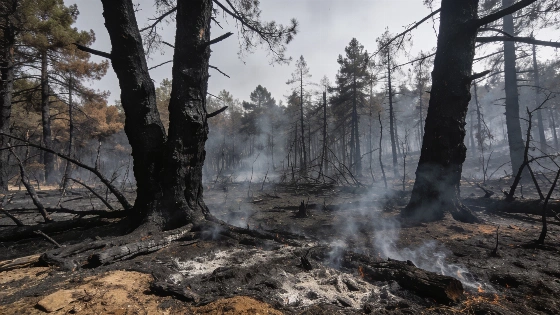
The PP refuses to negotiate a national climate pact, challenging the government’s push for unified action. Political tensions rise as wildfires intensify and calls for cooperation are ignored.
Spain’s main opposition party, the Partido Popular (PP), has firmly dismissed repeated government appeals for a cross-party agreement to address climate change, even as devastating wildfires continue to threaten large parts of the country. The government, led by Pedro Sánchez, has called for a national pact since last summer’s fires, renewing the plea after the recent tragedy in Almería that claimed 13 lives. Despite these appeals, the PP has shown no willingness to enter negotiations, signaling a deepening political divide as the country faces increasingly severe fire seasons.
The fragile political truce that briefly emerged during the weekend’s emergency response quickly unraveled. On Sunday, PP leader Alberto Núñez Feijóo avoided commenting on the government’s proposal during his visit to the Madrid fire command center, declining to make any political statements. By Monday, the party’s parliamentary spokesperson, Ester Muñoz, openly questioned the link between climate change and the surge in wildfires, suggesting that claims about climate-driven fatalities are used by the left to deflect from what she described as government mismanagement. Muñoz acknowledged that climate has always changed throughout history, but cast doubt on the extent of human responsibility, echoing arguments often associated with climate change skepticism.
Madrid’s regional president, Isabel Díaz Ayuso, also challenged the government’s narrative, arguing that most fires are caused by human action rather than climate factors and criticizing what she called “broad brush” solutions. This stance reflects the PP’s increasingly ambiguous position on climate issues, especially since forming regional coalitions with Vox, a party known for its climate denial rhetoric. In these agreements, the PP has adopted language rejecting the European Green Deal and denouncing what they term “ideological agendas” in environmental policy. Yet, even PP leaders who have signed such pacts, like Andalusia’s Juan Manuel Moreno, have at times acknowledged the reality of climate change when faced with local disasters.
The government’s push for a state pact began in August of the previous year, with a draft presented in September outlining measures such as climate shelters and a national civil protection agency. Consultations with experts and stakeholders followed, culminating in a document with 80 proposals, some of which—like the creation of a scientific advisory council—are set to proceed regardless of opposition support. However, the idea of a broad political consensus, similar to past agreements on gender violence or anti-terrorism, appears increasingly unlikely in today’s polarized climate, especially as the far right frames climate policy as a cultural battleground.
When the PSOE brought the pact to parliament, even some government allies voiced skepticism, labeling the initiative a “smokescreen.” Despite this, the government plans to continue its efforts, with another convention scheduled for autumn and a new call for organizations to join the pact. The end of the weekend’s brief political ceasefire was marked by renewed exchanges between parties. PSOE spokesperson Montse Mínguez accused the PP of adopting Vox’s denialist positions to avoid upsetting coalition partners, while Transport Minister Óscar Puente blamed the PP’s climate stance and public service cuts for worsening the summer fire crisis.
Recent wildfires in Madrid and central Spain have intensified the debate, with thousands evacuated and emergency services stretched thin. The scale of the crisis has drawn national attention, as highlighted in coverage of the mass evacuations and the challenges faced by authorities in containing the blazes. For example, the situation was detailed in a recent report on how extreme weather and multiple fire fronts forced entire communities to leave their homes, underscoring the urgent need for coordinated action (see the full story on the Madrid wildfire evacuations).
Spain’s struggle to forge a unified response to climate change comes as scientific consensus points to human-driven global warming as the main factor behind the increasing frequency and intensity of extreme weather events. The Intergovernmental Panel on Climate Change (IPCC) has concluded that fossil fuel emissions are the primary cause of the rapid changes now observed. The lack of political agreement not only complicates the implementation of national strategies but also risks undermining local and regional efforts to adapt to new climate realities. As wildfires become more destructive and adaptation grows more challenging, the absence of a state pact leaves Spain’s response fragmented at a time when coordinated action is most needed.