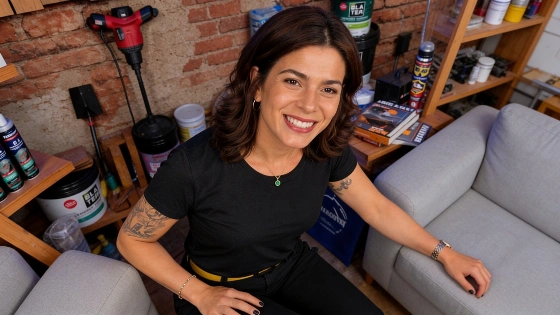
Priscila de Oliveira is one of the few women running a construction business in Spain. Her story shows what women face in a field still run by men. More women are joining, but the gap is still wide.
When Priscila de Oliveira drags 14,000 kilos of rubble out of a client’s apartment, she is not just clearing out trash. She is breaking old ideas about who belongs on a building site. Priscila is one of the few women running a construction company in Asturias. She built her name on hard work, skill, and not letting anyone else set her limits.
Only one out of every ten construction workers in Spain is a woman. That’s what the Observatorio Industrial de la Fundación Laboral de la Construcción reports. Construction is still one of the most male-heavy jobs in the country. Seeing a woman on a building site is rare. Priscila is part of a small but growing group. In 2025, the number of female bricklayers went up by 16.3%. Still, the gap is big. Many clients and coworkers still doubt what women can do.
In 2025, the value of construction production in Spain reached 181.9 billion euros, marking a 7.5% increase from the previous year.
Priscila deals with doubts by showing results. "A client trusted me with an entire apartment to clear out, and I removed 14,000 kilos of debris—bag by bag, breaking it up and loading it into a van," she says. Her company, A la brasileña, stands out for its hands-on style and strong social media presence. People often call her "la brasileña" online.
For Priscila, working for herself is not just a choice. It’s the only way. "I love being self-employed. I wouldn’t go to work for a company for less than 2,000 euros a month," she says. More women in construction work as freelancers than in other fields. About one in four female builders in Spain is self-employed. That’s twice the rate in the rest of the labor market. Priscila says the freedom is worth it. "Last year I took a whole month off to visit Brazil. What company would let me do that?" She wants to control her own time and workload.
Even with more women joining, the culture in construction changes slowly. Priscila says she once wondered if clients would trust a woman with a big job. "I questioned if anyone would believe a woman could do the job well, since it’s such a male-dominated field," she says. She learned that trust comes from what you do, not what people expect.
Although the number of women in Spanish construction reached a 20-year high in 2025, women still make up only about 11–11.5% of the workforce, with nearly 9 out of 10 workers being men. This slow progress is confirmed by recent reports from sector analysts.
The numbers show slow but steady change. There are now 166,833 women working in Spanish construction. More women are showing up on job sites and in leadership. But men still make up most of the workforce. For women, the path is still steeper and lonelier than it is for men.
Priscila’s story shows both the chances and the roadblocks for women in construction. She fights for fair pay and her own freedom. Many women choose self-employment, which shows that most companies still have not changed to fit what women want or need.
The industry is changing, but slowly. Stories like Priscila’s show that women are not waiting for permission. They are stepping in and making their own way. More women are joining, but real change will come when seeing a woman on a building site is just normal, not a surprise.