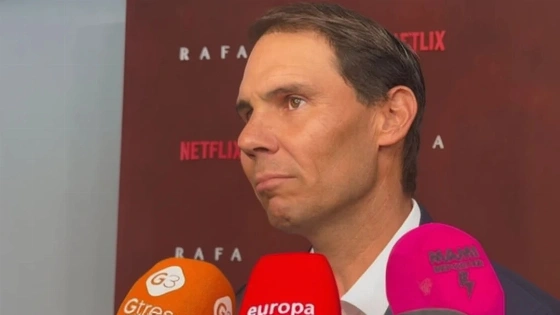
Rafa Nadal explains why he took so long to agree to a documentary about himself. Rafa Nadal has openly shared for the first time why he was hesitant to show his private life in a documentary project. The main reason was concern for the boundaries of his family and loved ones. Now, he has decided to be candid.
Rafa Nadal once again found himself at the center of attention in the Spanish media—and this time, not because of another victory on the court, but due to the premiere of the long-awaited documentary “Rafa” on Netflix. The premiere evening was full of intrigue: both the public and journalists were expecting not only new details about Nadal’s sports career, but also rare glimpses into his closely guarded private life. It was this move—letting cameras into his home—that became the most difficult step of Nadal’s entire career.
As Divinity notes, Nadal has always been someone who carefully protects his private space. Even at the height of global fame, he never allowed himself to publicly reveal details about his family, preferring to keep a firm line between the court and home. Speaking on the red carpet, Nadal admitted that agreeing to filming wasn’t easy for him. His greatest fear was not for himself, but for those close to him. He does not hide that the idea of showing not just training and matches, but also moments with his wife, family, and friends, caused him serious doubts. “That was the very line I was afraid to cross,” the tennis player shared.
Family as support
In the film “Rafa,” viewers will see for the first time what Nadal’s everyday life is like off the tournament circuit. He emphasizes that choosing to stay in Mallorca, despite all the offers and temptations of the outside world, was a matter of principle for him. It is precisely his home island and his closeness to family, Nadal says, that helped him maintain inner balance and not lose himself in the whirlwind of fame. This theme runs through the entire film—and becomes one of its central subjects.
However, the documentary is not limited to family scenes. Nadal promises viewers will see the other side of success as well—injuries, difficult periods, moments when it seemed that sports could take everything away. He admits even his most devoted fans don't know many details of his struggle to return to the court. This 'unvarnished realism' became another reason for Nadal to agree to the project.
The line between fame and home
Spanish society pages have often discussed why Nadal refused for so long to participate in a film about himself. Now the answer was made public: it's not about a reluctance to share his success, but about a fear of disturbing the peace of his loved ones. For Nadal, family is not part of a public image, but a personal territory he protects especially zealously. The film portrays this boundary with maximum delicacy: cameras never intrude where truly personal matters begin.
Interestingly, the topic of family boundaries and public confessions has become increasingly prominent in Spanish media in recent years. For example, there was much discussion about a touching gesture by Ana Obregón, who for the first time shared details of her last conversation with her son—more about this story can be found in the article about a rare confession of a mother.
Openness without sensationalism
The premiere of “Rafa” has already sparked a wave of discussion: viewers note that the film is not sensational, but honest and deeply personal. Nadal does not turn his life into a show, but for the first time allows us to see what it's like to be a legend while remaining an ordinary person to his loved ones. According to Divinity, this very balance between publicity and personal space became the central nerve of the project.
Stories where a star so consistently protects their family from excess attention are rare in the Spanish show business. Nadal's story is yet another reminder that even the most famous people have the right to their own boundaries. And perhaps that is exactly why his candor now attracts such interest.