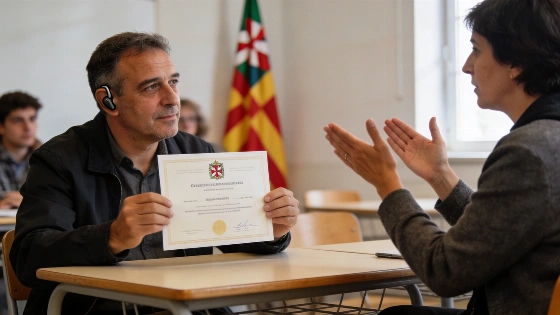
Basque Country Issues First Adapted Basque Language Certificates for People with Disabilities. In the Basque Country, it is now possible to obtain an official Basque language certificate based on individual abilities. The new regulations allow people with disabilities to certify only the language skills accessible to them. This is the first such initiative in Spain.
The Basque Country has officially begun issuing adapted Basque language certificates (Euskera) for people with disabilities. Now, candidates can certify only the language skills that correspond to their abilities or job requirements. This decision is the first of its kind among all of Spain’s autonomous regions and has already allowed several dozen people to have their knowledge recognized.
The changes to the exam system took effect after a revision of the regional decree two years ago. Since then, more than ten people with disabilities have taken exams under the new scheme. For example, Raúl Anta, a public administration employee from Bilbao, was able to obtain a B2 certificate by demonstrating reading and writing skills without the oral and listening components. For people with mental disabilities, conversely, the exam is limited to the oral part. The time limit for such candidates has also been removed.
In 2024, 26,548 people took intermediate and advanced level Euskera exams, compared to 28,032 the previous year. The most popular remains the C1 level. In two years, fourteen students have used the partial exam option: five at B1 level and nine at B2. Among them, two passed at B1 and five at B2, including Anta.
The new system not only takes disabilities into account, but also adapts the exam to real workplace tasks. For example, an employee working with people may demonstrate a high level of speaking and listening skills, but an average level in writing and reading. This approach is called the 'asymmetric exam'. According to authorities, there are currently no official equivalents for Spanish, Catalan, or Galician. In other regions, there may be certain accommodations for people with disabilities, but they do not provide an official certificate for future competitions or career advancement.
Jokin Askue, director of HABE (the Basque Adult Language Learning Institute), notes that splitting skills by level better reflects the real job requirements. According to him, learning Basque takes more time than learning Galician or French, and the new system allows civil servants to gradually build language competencies and apply for positions without waiting to master all skills completely.
Work on the reform began during the pandemic. As Aitor Bedialauneta, head of the federation of associations of the deaf in the Basque Country, recalls, discussions took a long time, but in the end the decision allowed many to obtain certificates on par with others. He emphasizes that for the deaf, the learning process is different, and the exam must take these features into account.
The regional authorities acknowledge that a successful reform requires each euskaltegi (Basque language school) to have a specialist capable of supporting people with disabilities. This involves not only sign language interpreters, but also methodological support that takes into account residual hearing and other nuances. According to community representatives, the key to success lies not only in technical adaptations, but also in creating a safe learning environment.
Sign language in the Basque Country has its own features, but is officially considered a dialect of Spanish Sign Language. It includes unique local expressions and cultural elements that reflect the region's identity. For many deaf people who do not speak Basque, this becomes an additional barrier to integration.
Issues of adapting exams and recognizing language skills for different population groups are becoming increasingly relevant amid changes in Spain's migration and social policy. For example, in Barcelona, foreigners without housing face difficulties in obtaining documents for legalization — more details about this can be found in the material on new barriers for homeless migrants.
For reference: Basque is one of the oldest languages in Europe and is not related to any Indo-European language groups. In the Basque Country, it has official status alongside Spanish. Certificates in Basque are required for work in government institutions, as well as for career advancement. The new system for recognizing language skills may serve as an example for other regions of the country.