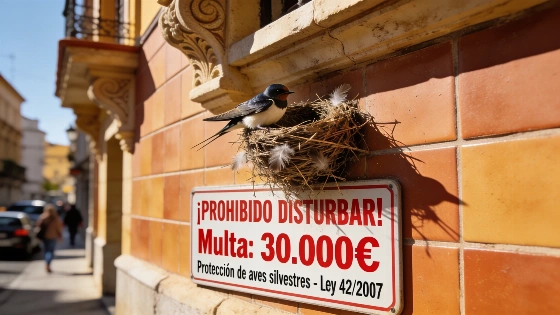
In Spain, destroying or removing nests of swallows, swifts, or house martins without official permission can result in fines reaching €200,000. These birds and their nesting sites are protected by law, and even empty nests are off-limits without proper authorization.
Anyone considering removing a swallow, swift, or house martin nest from their property in Spain faces more than a simple cleaning job. Under Spanish law, these birds and their nests, eggs, and chicks are strictly protected, and unauthorized removal—even when nests seem abandoned—can lead to severe financial penalties.
The legal framework is clear: Spain's Law 42/2007 on Natural Heritage and Biodiversity prohibits damaging, destroying, or removing nests of protected wild bird species. Violations deemed serious can result in fines ranging from €3,001 to €200,000. This applies not only to active nests but also to those that appear empty, as many birds return to the same site year after year to breed.
Heavy Fines for Nest Removal
Swallows, swifts, and house martins migrate thousands of kilometers from Africa to Spain each spring, often returning to the exact spot where they previously raised their young. Destroying a nest can mean the loss of a crucial breeding site for these species. Article 57 of Law 42/2007 specifically bans the destruction or deterioration of nests, burrows, and breeding or resting places for species listed under Spain's Special Protection Regime.
Most illegal nest removals occur during building renovations, facade repairs, or maintenance work. According to SEO/BirdLife, both national and European regulations protect these birds and their nests, and removal is only allowed with explicit authorization from the relevant environmental authority.
When Is Removal Permitted?
Exceptions to the ban on nest removal are rare and require administrative approval. The law allows for removal only when there is no satisfactory alternative and the conservation status of the species will not be harmed. Acceptable reasons include public health and safety, prevention of aviation hazards, protection of other wildlife, or for research, education, or reintroduction projects.
For construction or renovation projects, property owners must apply to their regional environmental department. Any authorization must specify the affected species and set clear conditions for the work. SEO/BirdLife also emphasizes that permits should avoid the breeding season and, if removal is unavoidable for safety reasons, alternative nesting options should be provided.
Why These Birds Matter
Swallows, swifts, and house martins play a vital ecological role. As insectivores, they consume large numbers of flies, mosquitoes, and other insects during spring and summer. SEO/BirdLife estimates a single swallow can eat up to 850 insects per day, helping to control pests naturally.
Their presence benefits both urban and rural environments by reducing insect populations and supporting agricultural balance. Anyone witnessing nest destruction, blocked nest entrances, or the use of nets to prevent birds from accessing their breeding sites can report it to the Guardia Civil's Seprona unit or the regional environmental authority.
Spain's approach to wildlife protection is not limited to birds. In a related case, a retired farmer in La Rioja was ordered to repay nearly €47,000 after authorities found he continued managing his agricultural business while receiving a full pension, highlighting the country's strict enforcement of environmental and social regulations. More details on this can be found in this report on pension and farm work conflicts.