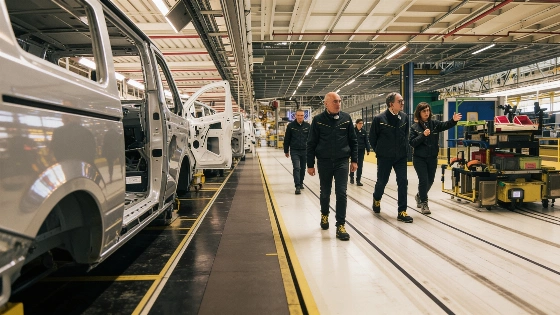
Renault is doubling down on its Spanish factories, launching a new wave of hybrid SUVs that aim to match Toyota’s legendary reliability. With over €600 million invested and five new models secured, Spain’s auto industry is firmly in the spotlight.
Renault has raised the stakes in the hybrid car race. The company now claims its Spanish-built E-Tech models are almost as reliable as Toyota’s. Renault’s leaders say their latest SUVs from Palencia and Valladolid trail the Japanese standard by just 0.2 points. That’s a bold claim in a tough market.
Palencia and Valladolid, both in Castilla y León, now anchor Renault’s European plans. These plants turn out the Captur, Symbioz, Austral, Espace, and Rafale. All five go to buyers across Europe. The E-Tech hybrid versions are catching on fast. Buyers want them for their low fuel use. They’re quickly becoming the top pick in showrooms.
According to the official Renault España catalog, the Captur full hybrid E-Tech 160 is rated at 4.4 l/100 km fuel consumption and 160 hp, while the Symbioz hybrid shows 4.3–4.4 l/100 km depending on the version.
Renault backs up its confidence with numbers. The Captur and Symbioz hybrids both use a four-cylinder petrol engine with 110 CV and a 1.4 kWh battery. Each one posts 4.4 l/100 km fuel use. Starting prices, with financing deals, are €24,635 for the Captur and €26,443 for the Symbioz. The Austral, Espace, and Rafale hybrids use a 200 CV system built around a 1.2-litre three-cylinder engine and two electric motors. They reach 4.7–4.8 l/100 km. Prices start at €31,543, €34,669, and €36,354.
These Spanish plants stand out for more than just output. Their future looks strong. Renault has locked in five new C and D segment models for Palencia and Valladolid. The €600 million investment and the plants’ high productivity made it possible. This keeps jobs safe and puts Spain at the center of Europe’s car industry. That was reported earlier by industry sources.
At a press event in Zaragoza’s Mobility City, Renault’s Erdem Kizildere was direct: “Estamos al nivel de Toyota, sólo a 0,2 puntos.” For a brand long in Toyota’s shadow, that’s a big statement. The Spanish-built E-Tech hybrids are now pitched as a real alternative to Toyota’s grip on the segment.
Official Spanish catalogs confirm the Austral full hybrid E-Tech 200 delivers 200 hp and a combined fuel consumption of 4.7 l/100 km. However, the detailed composition of its hybrid system—such as the specific three-cylinder engine and two electric motors—should be verified with press dossiers or homologation documents, as commercial cards do not provide full technical breakdowns.
The Clio E-Tech hybrid is also on sale, but it’s not made in Spain. Renault’s focus is clear. Palencia and Valladolid are now the company’s showcase for Spanish engineering and manufacturing skill.
Renault’s new push in Spain is about more than numbers. It marks a shift in how Spain is seen in the global car world. Big investments and a growing hybrid lineup mean Spain is no longer just an assembly line. It’s becoming a hub for innovation and reliability. Buyers get more choice. The ‘made in Spain’ badge now carries new weight. For the industry, it’s a sign the hybrid battle is heating up. Renault wants Spain to lead the charge.