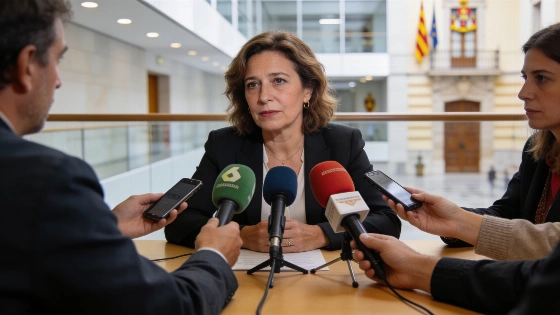
Salvador Illa and most Catalan parties have condemned Ripoll’s mayor for appointing her daughter to the local police. The debate centers on public ethics, not legality. The case exposes tensions over transparency in municipal hiring.
The appointment of Sílvia Orriols’s daughter as an interim officer in Ripoll’s local police has triggered a wave of criticism from Catalonia’s political leadership. President Salvador Illa and the majority of parliamentary groups have publicly questioned the ethics of the move, highlighting concerns about transparency and conflict of interest in municipal hiring. The controversy has overshadowed legal aspects, with the focus shifting to the standards expected from public officials.
Salvador Illa, addressing the issue during a press conference marking the midpoint of his mandate, emphasized that setting oneself up as a moral authority is unwise, especially when personal decisions come under scrutiny. He clarified that the Generalitat had no involvement in the interim hiring process, as it was managed locally. However, he noted that the regional government will participate in the upcoming competitive exam for a permanent police position, in which Orriols’s daughter is also a finalist.
Sílvia Orriols, who leads the far-right Aliança Catalana and has often criticized traditional parties for nepotism, defended her decision by stating that her daughter underwent a selection process with proper guarantees. She argued that the situation is not comparable to direct appointments without competition. Despite this, many see a clear conflict of interest, as Orriols remains the direct superior of her daughter within the police force.
Political reactions have been swift. Junts per Catalunya, the only party to demand explanations during the municipal session where the hiring was announced, proposed that Orriols delegate security responsibilities to another councillor to ensure transparency. The mayor rejected this suggestion outright. Esquerra Republicana’s spokesperson, Ester Capella, also flagged the ethical dilemma, pointing out that even if the process followed urgent hiring rules, the optics remain problematic. She criticized Orriols for failing to recognize her own contradictions.
Other parties have not held back. Jéssica Albiach of the Comuns described the episode as typical of the far right, accusing Orriols of opportunism and nepotism. Pilar Castillejos, representing the anticapitalist bloc, argued that the incident exposes a pattern of double standards within Aliança Catalana, where public rhetoric about transparency clashes with questionable internal practices.
The debate comes at a time when Catalan politics is already tense, with shifting alliances and rising scrutiny of public appointments. The rapid ascent of Aliança Catalana has unsettled the traditional balance in the Parliament, as highlighted in recent developments covered by reports on the changing parliamentary landscape. The Ripoll case adds fuel to ongoing discussions about the need for stricter ethical standards in local administrations.
In Spain, public sector hiring is subject to both legal and ethical oversight, but interim appointments often fall into grey areas where transparency can be questioned. While the law may allow relatives to compete for positions, the perception of fairness is crucial for public trust. The current controversy in Ripoll underscores the persistent challenge of ensuring that local governments adhere to both the letter and the spirit of ethical governance. As scrutiny intensifies, the outcome of the permanent police recruitment process in Ripoll will likely be watched closely across Catalonia.