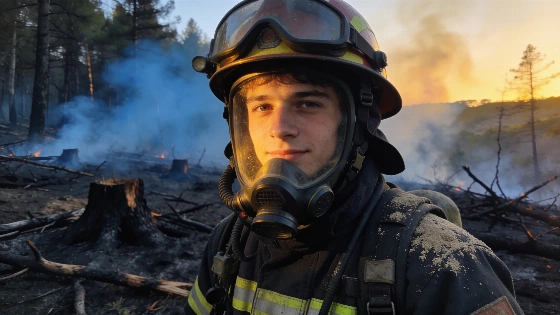
A young firefighter describes the intensity of Madrid’s largest wildfire. Night shifts, destroyed landscapes, and the drive to return to the front lines shape his first year in a permanent post.
Madrid’s most severe wildfire in recent memory has pushed emergency crews to their limits, with young firefighter Luis experiencing his first year in a permanent role amid the crisis. At just 25, Luis has already spent four summer campaigns battling flames across the region, but this season stands out for its scale and intensity. Authorities have called it the worst fire in the region’s history, with more than 77,000 hectares affected across three autonomous communities as of Monday.
Assigned to the night shift near San Martín de Valdeiglesias—one of the hardest-hit municipalities—Luis joins a five-person crew each evening. Their work begins at 10 p.m., when they gear up and head out in small, agile teams to confront the advancing fire. The operation is tightly coordinated, with constant updates on weather and terrain. Luis describes the atmosphere as tense and focused, with little room for conversation as every member listens for critical instructions.
During the long nights, Luis says his mind clears, leaving only the immediate demands of the job. The destruction is visible: scorched trees, dead animals along the roadside, and blackened landscapes. Despite the exhaustion, he admits to feeling a strong urge to return to the fire after his two days of rest, driven by the desire to save as much as possible. The emotional toll is evident, especially for his family—his mother leaves dozens of messages when she knows he is on duty, and he always contacts her after each shift, sometimes opting for a text if she is asleep.
Sunrise offers a brief respite. As daylight breaks around six in the morning, Luis and his team can finally see the results of their efforts, navigating the terrain more safely and assessing the night’s progress. Yet the fire remains far from contained, with forecasts warning of another heatwave and shifting winds that could complicate operations further. The situation echoes recent emergencies in other parts of central Spain, such as the mass evacuations in Ávila, where firefighters faced dense smoke and unstable winds during a major wildfire near Burgohondo.
For Luis, firefighting is both a calling and a challenge. He has combined seasonal fire work with jobs as an electrician, gardener, and musician, and recently completed a degree in forest management. His first experience with fire came at 22, tackling a grass blaze near San Lorenzo del Escorial. Now, with a permanent position and a salary averaging €35,000 gross per year, he sees the profession as a lifelong commitment. He values the camaraderie among his colleagues, noting that the shared struggle against the flames forges a unique bond. Luis avoids checking the time during shifts, preferring to focus on the task until the end, and keeps physically prepared by running, going to the gym, and occasionally playing football with friends.
Wildfires are a recurring threat in Spain, particularly during the hot, dry summer months. The combination of high temperatures, low humidity, and strong winds can quickly turn small blazes into major emergencies. Firefighters like Luis play a crucial role in protecting rural communities and natural landscapes, often working under extreme conditions. Their efforts are supported by regional and national authorities, but the scale of recent fires highlights the ongoing challenges posed by climate and land management. As the current wildfire continues to burn, the dedication of crews on the ground remains vital to limiting further damage and safeguarding lives and property.