Pedro Sánchez refuses to intervene in the case of jewels kept by Zapatero. The president insists on public use but avoids direct criticism. Election timing for 2027 remains open.
The dispute over jewels valued at €1.3 million, kept by former Prime Minister José Luis Rodríguez Zapatero, has placed Pedro Sánchez in a delicate position. Despite daily communication and continued political support for Zapatero, Sánchez has made it clear he will not personally intervene in the controversy. Instead, he insists the decision to hand over the jewels to Patrimonio Nacional for public use rests solely with Zapatero.
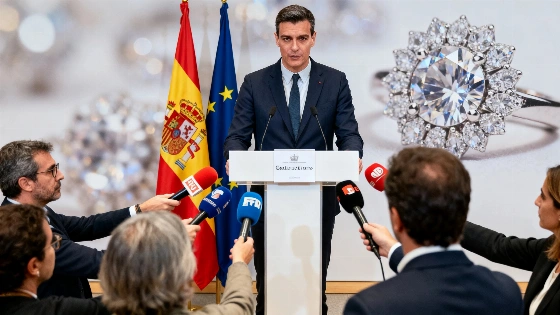
During a press conference in Brussels following the European Council, Sánchez faced repeated questions about the origin and fate of the jewels, which Zapatero received as a gift while in office in 2007. Unlike his then-minister Miguel Sebastián, who handed over a similar gift to the state, Zapatero chose to keep the items. Sánchez avoided labeling this as a mistake but emphasized his preference for the current system, where official gifts are either returned to the giver or transferred to state ownership, never remaining in the possession of presidents or their families.
Pressed on whether he would return the jewels if he were in Zapatero’s place, Sánchez declined to answer directly, stating that only Zapatero could make that decision. This approach allows Sánchez to maintain his support for the former leader, even as Zapatero faces legal scrutiny and his family deals with the fallout of related investigations.
Throughout his remarks, Sánchez refrained from criticizing Zapatero, instead highlighting that it was Zapatero himself who introduced the Good Governance Code requiring the return of such gifts. However, Sánchez did not explain why the jewels have not yet been handed over to the state, despite acknowledging that the current rules make private retention of such items unreasonable.
On the broader political front, Sánchez also addressed speculation about a possible early general election if the government fails to pass the budget. He clarified that the next general elections will be held in 2027 and will not coincide with municipal and regional votes, ruling out the so-called 'super Sunday' scenario. However, he left open the question of whether the general elections would take place before or after the local polls, citing the dynamic nature of political life and indicating that the final decision will depend on future circumstances.
Sánchez’s stance reflects a desire to complete the full legislative term, a point he underscored by referencing the history of early elections under previous Socialist governments. He argued that, unlike the right, left-leaning administrations should also serve full four-year terms when possible. This position is seen as a response to pressures from within his party and from regional leaders, some of whom prefer an earlier election to avoid negative spillover from national politics.
For context, Spanish law requires that official gifts received by public officials be registered and, in most cases, transferred to state ownership. The Good Governance Code, introduced during Zapatero’s tenure, formalized these requirements. The current debate highlights ongoing challenges in enforcing these rules and the political sensitivities involved when high-profile figures are implicated. The outcome of the jewel case may set a precedent for how similar situations are handled in the future.