Pedro Sánchez changes strategy in Congress after a year of scandals. The government now focuses on Ayuso’s partner’s contracts. Tensions rise as PSOE and PP face corruption cases and judicial scrutiny.
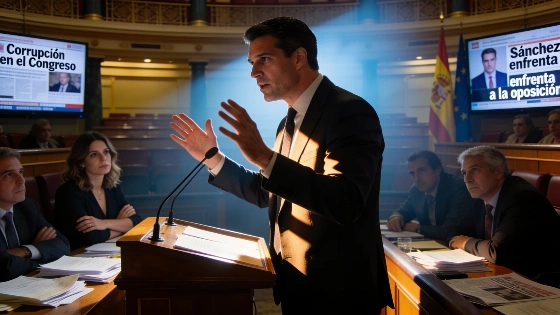
Pedro Sánchez is preparing for a critical session in Congress, moving from last year’s defensive stance to a direct attack on the opposition. The Prime Minister, weakened by a series of corruption scandals within his own party and poor regional election results, is now aiming to shift the spotlight onto the Partido Popular and, specifically, Isabel Díaz Ayuso.
This change in approach comes after a turbulent year for Sánchez. In 2025, the fallout from the ‘caso Cerdán’ left his leadership in jeopardy, forcing him to publicly apologize and announce anti-corruption reforms. Despite these measures, many of the promised changes remain stalled or under debate. Now, with the PSOE facing even lower poll numbers and the recent conviction of former minister José Luis Ábalos to 24 years in prison, the government is under renewed pressure.
The latest controversy centers on Ayuso’s partner, Alberto González Amador. According to a recent UCO report, González Amador’s earnings from Quirón, a major healthcare contractor for the Community of Madrid, surged to €4.4 million after his relationship with Ayuso began. The government argues this is not a private matter, linking the financial gains directly to Ayuso’s political influence. Under her leadership, Quirón has secured contracts worth up to €5 billion, intensifying scrutiny over potential conflicts of interest.
Sánchez’s team is determined to draw a sharp contrast between the PSOE’s handling of corruption and the PP’s response. While the Socialists have distanced themselves from figures like Ábalos, Cerdán, Koldo, and Leire, the PP has not taken public action regarding Ayuso’s partner. The Prime Minister is expected to highlight this difference, emphasizing that his party removes those implicated in scandals, while the opposition remains silent.
The debate is further complicated by Sánchez’s own family situation. His wife, Begoña Gómez, is facing judicial measures, including a possible passport withdrawal. The government frames this as evidence of political interference by the judiciary, a point Sánchez may use to rally support among progressive MPs and reinforce the narrative of institutional bias against the executive.
Government sources indicate that Sánchez will also address coalition partners’ demands for substantive legislative progress. The recent approval of increased dependency spending, aiming for €7.2 billion annually by 2027, is presented as a key achievement. The Prime Minister is expected to argue that such reforms justify continuing the legislature until at least March 2027, despite mounting challenges.
Justice Minister Félix Bolaños has publicly acknowledged the blow dealt by Ábalos’s conviction, stressing the government’s respect for judicial decisions in cases with full legal guarantees. However, he contrasted this with concerns over the handling of the case against Begoña Gómez, suggesting irregularities in the judicial process.
As the session approaches, tensions between the PSOE, PP, and Vox are set to escalate. The government’s strategy is to underline its willingness to confront corruption internally, while pressing the opposition to address unresolved scandals in its own ranks. The outcome of this debate could shape the political landscape as both parties navigate ongoing investigations and public scrutiny.
For context, Spain has seen a series of high-profile corruption cases in recent years, affecting both major parties. The Community of Madrid, under Ayuso, has faced repeated questions over public procurement during the pandemic. Meanwhile, judicial independence and the role of political influence in legal proceedings remain contentious issues, with several ongoing cases drawing national attention. The current standoff in Congress reflects broader concerns about transparency, accountability, and the stability of the government as it approaches the final stretch of the legislature.