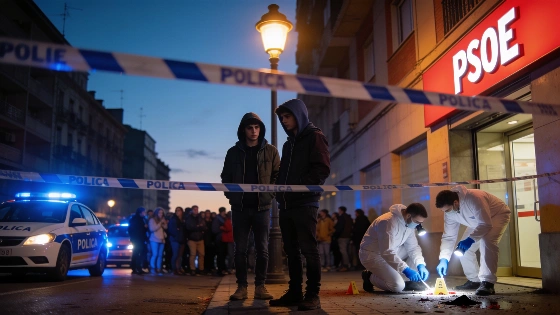
A Santander judge has proposed criminal charges against two young men for an explosive attack on the PSOE headquarters during a public event in 2025. The case highlights rising political tensions and the risk of violence at party gatherings.
A court in Santander has taken a decisive step toward prosecuting two young men, Miguel Toribio and René Odriozola, for their alleged involvement in an explosive attack on the PSOE headquarters in April 2025. The incident occurred during a public conference on democratic memory, attended by over fifty people, including local officials and senior party figures. The judge, Mercedes Compostizo, concluded that there is sufficient evidence to proceed, citing the suspects' radical ideology and their links to the far-right group La Falange.
According to the judicial investigation, the attack unfolded at 19:15 on April 25, 2025. René Odriozola, reportedly masked, entered the PSOE premises where the event was underway. He placed two bottles—one 1.5 liters and another 6 liters—behind a participant's chair. These containers held homemade explosive devices, assembled from metallic aluminum and hydrochloric acid, which were activated remotely about 25 seconds after being left on the floor. The rapid reaction of an attendee, who removed the bottles from the building before they detonated, prevented serious injuries, though she later required psychological treatment.
The PSOE, acting as a private prosecutor, is seeking a sentence of 14 years and 9 months for each defendant. The charges include manufacturing explosives, attempted disruption of the right to assembly, and causing injuries. The party has also requested that hate crime and assault on authority be added to the indictment. The judge's order, issued on June 17, details how the suspects allegedly planned and executed the attack, motivated by their opposition to the PSOE and the event's focus on renaming city streets under the Democratic Memory Law.
Evidence cited in the case includes the suspects' own statements, security camera footage from a nearby hotel showing them carrying bags with the necessary materials, and mobile phone data placing them near the PSOE office before the incident. Police reports also note a handwritten note found in one of the bottles, reading: “Frente a mentiras revanchistas, PSOE satanás.” Investigators believe this message was intended for broader dissemination, not just for those present at the event.
One of the accused is reportedly the son of a PP mayor from a Cantabrian town, further intensifying the political sensitivity of the case. The attack is seen as part of a broader pattern of escalating hostility against the PSOE, which has included vandalism, cyberattacks, and far-right protests outside party headquarters. In the aftermath, Pedro Sánchez publicly reaffirmed the party's commitment to memory, respect, and justice, referencing the need to honor those who fought for democracy.
Spain has witnessed a rise in politically motivated incidents targeting party offices and public events in recent years. The use of homemade explosives, while rare, underscores the potential for violence amid polarized debates over historical memory and street renaming policies. The case in Santander is being closely watched as a test of how the justice system responds to ideologically driven attacks on democratic institutions. For context, recent months have also seen heightened public concern over safety in public spaces, as highlighted by incidents such as the Ryanair flight emergency, where passengers narrowly avoided disaster after a window shattered mid-flight—details of which can be found in this report on a recent aviation incident.
The upcoming trial will likely draw national attention, not only for its legal implications but also for what it reveals about the current climate of political confrontation in Spain. The outcome may influence future security measures at political events and shape the ongoing debate over how to address hate-motivated violence in the country.