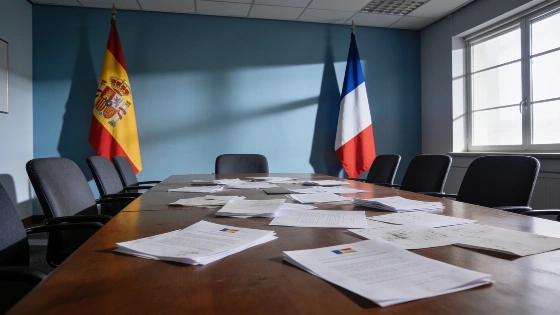
The Senate, led by the PP, has blocked the Spain-France friendship treaty. A new constitutional review suspends its approval. The move raises diplomatic tensions and leaves vital cooperation in limbo.
The Spain-France friendship and cooperation treaty, signed in Barcelona in January 2023, remains stalled after the Senate, where the Partido Popular (PP) holds an absolute majority, initiated a new constitutional review. This move has suspended the treaty's approval process, creating uncertainty over when, or if, the agreement will come into force.
The PP's main objection centers on a clause allowing Spanish and French ministers to attend each other's cabinet meetings on a rotating basis every three months. While similar arrangements exist between France and other European partners, the PP argues that this provision violates the Spanish Constitution, which strictly defines the composition of the government.
To address these concerns, Spain's Foreign Minister José Manuel Albares and his French counterpart Jean-Noël Barrot signed an interpretative agreement in April. This clarification stated that visiting ministers would only participate in separate, ad hoc meetings on the sidelines of cabinet sessions, not in the executive meetings themselves. Despite this, the PP maintains that such clarifications do not alter the treaty's official text and insists on a constitutional review.
The government sees the PP's actions as an attempt to undermine Prime Minister Pedro Sánchez on the international stage, especially ahead of his planned visit to Paris for France's national day on July 14. Albares has publicly criticized the PP for what he describes as a dangerous game, warning that delaying the treaty could harm Spain's interests and its relationship with its main trading partner.
Diplomatic sources in Spain highlight the practical impact: since January 2023, no high-level bilateral meetings involving multiple ministers have taken place. The treaty was intended to provide a framework for cooperation across areas such as cross-border relations, culture, European policy, and energy connections. With the process now frozen, these initiatives remain on hold.
French diplomatic sources have expressed disbelief and frustration at the impasse, suggesting that the delay will be seen in France as a diplomatic slight, regardless of the internal Spanish political dynamics behind it.
This is not the first time the PP has challenged the so-called Barcelona Treaty in the Constitutional Court. A previous attempt was dismissed after the treaty was initially rejected in the Congress. However, after a renewed vote in June, the agreement passed the lower house with support from Podemos and Junts, despite opposition from the PP and Vox.
The current deadlock means that Spain cannot confirm when the treaty will be ratified, if at all. The situation also affects the 300,000 Spaniards living in France, the 1.3 million residents in border regions, and the 13 million French tourists who visit Spain annually. The government argues that the treaty is essential for protecting Spanish exports and maintaining strong bilateral ties.
Spain and France share one of the longest land borders in Western Europe, with extensive economic, cultural, and infrastructural links. Bilateral treaties like the one now blocked are rare and typically signal a high level of trust and strategic partnership. The ongoing suspension not only delays new joint projects but also sends a signal of political division at a time when cross-border cooperation is increasingly important for both countries.