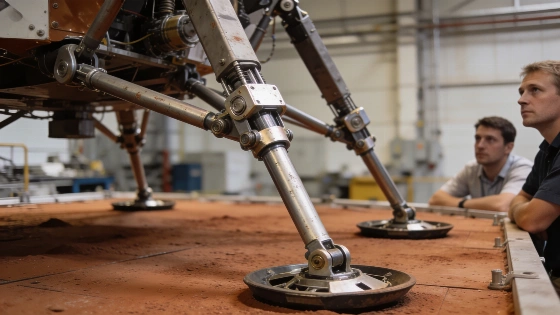
Sener is finishing the final qualification work on Rosalind Franklin's landing gear. The four-leg system must deploy in under one second before the 2028 mission begins its search for signs of life on Mars.
On 1 October, ESA is due to test autonomous navigation in the Tabernas desert in Almería. The campaign will use the remotely operated experimental vehicle "Charlie", controlled from Turin. The test will recreate scientific work planned for Mars.
Sener is finishing the qualification campaign for Rosalind Franklin's landing gear. Flight units are due for delivery in the fourth quarter of 2026. The ExoMars launch is planned for 2028.
The margin is tiny.
Four legs must unfold in less than one second before the landing platform reaches the Martian surface. The mechanism travels folded during descent. It opens automatically just before contact with Mars.
Non-explosive actuators trigger the deployment. Parachutes and braking engines help control the descent and landing sequence.
The landing platform is designed to safely set down a 310-kilogram rover and keep it stable after touchdown. Airbus was appointed the main contractor for the platform in 2025, including its mechanical, thermal and propulsion systems.
Sener and the programme's main contractors, Thales and Airbus, have already run structural, environmental and functional tests. The remaining work comes before the handover of the mission units.
Reports published on 29 and 30 September 2026 said Sener was in the final qualification phase. The same reports put delivery of the flight hardware in the fourth quarter of 2026.
That window drives the test work.
Rosalind Franklin is being built to drill as deep as two metres below the Martian surface. No previous Mars rover in this programme has carried out that task. The rover will study samples shielded from radiation and the harsh conditions at ground level. Those samples will help scientists examine the planet's subsurface geochemical environment.
ExoMars was reconfigured after cooperation between the European Space Agency and Roscosmos ended. European industry then had to develop systems that had originally been expected from the Russian agency. The target launch date remained 2028.
Sener's landing gear is therefore a flight-critical mechanism. It also shows the industrial work needed to keep the mission on schedule.
The current mission schedule calls for launch in 2028 and an expected Mars landing around 2030. ESA has also reported a successful separation test of the landing platform from its backshell, with the four legs deployed in a slowed-down test sequence.
The landing platform must carry a 310-kilogram rover and keep it stable after touchdown. Airbus became the platform's main contractor in 2025. Its responsibilities include the mechanical, thermal and propulsion systems, as Airbus says in the quoted project description.
Sener's work covers more than the four legs. The Spanish company is supplying separation mechanisms and an adapter for the entry capsule. It is also providing the UHF communications antennas used during descent.
On the rover, Sener is responsible for the positioning and translation system for the drill. The company is also supplying the solar-panel deployment mechanism.
Several links depend on those parts.
Another component is the umbilical release mechanism. Made in Poland, it provides the electromechanical connection between the rover and the descent module.
Sener has also worked on antenna-pointing mechanisms for Curiosity and Perseverance. NASA used those rovers on the Mars Science Laboratory and Mars 2020 missions.
This European aerospace work sits alongside other examples of Spanish industrial activity, including an earlier industry report on Ford Almussafes. That comparison does not change the technical challenge at ExoMars. It places Sener's work within a wider record of high-value engineering and manufacturing commitments.
ESA's next public test will move from qualification hardware into the field. In the Tabernas desert, "Charlie" will be controlled from Turin on 1 October. The campaign will test autonomous navigation and recreate planned scientific activities.
ESA reported a separate test on 26 September. The landing platform separated successfully from its backshell. Its four supports deployed in a slowed-down scenario.
The mission schedule calls for launch in 2028 and an expected Mars landing around 2030. According to Sener and the European Space Agency, the work supports that launch plan after the programme's redesign.
Everything must work in sequence. Separation, communications, drilling and surface operations all depend on linked mechanisms. Sener's nearly qualified landing gear gives that chain a precise physical test: four legs must open correctly before touchdown.
The task is central to Europe's attempt to keep Rosalind Franklin on schedule.