Running air conditioning all night may not be as expensive as many fear. The final cost depends on your device, insulation, and electricity plan—sometimes as little as one euro per night. Experts explain how to minimize your bill without sacrificing comfort.
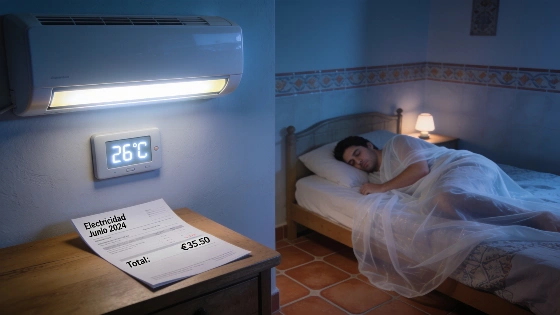
Leaving the air conditioning on through a hot summer night is a common solution for many in Spain, but the real impact on your electricity bill is often misunderstood. According to Carlos Llull, a specialist in climate control and energy efficiency, the cost of running a modern air conditioner for eight hours can be as low as one euro—provided you use a recent inverter model and set a reasonable temperature.
That figure, however, is only a guideline. The actual expense depends on several factors: the power rating of your unit, the insulation quality of your home, and the specifics of your electricity tariff. Poor insulation forces the system to work harder, while a well-sealed room helps maintain cool air with less effort. As Llull notes, the more heat that seeps in, the more energy your air conditioner will consume.
How Inverter Technology Changes the Equation
Many people assume that the maximum power rating of their air conditioner reflects its hourly consumption, but this is rarely the case with inverter models. These devices are designed to cool the room quickly and then reduce their output, maintaining the set temperature with far less energy. This means the real overnight consumption is often much lower than simply multiplying the maximum wattage by eight hours.
During the early hours, once the room has reached the desired temperature, inverter units operate at a fraction of their peak power. If your windows and doors are well sealed, the system needs only minimal energy to keep the space comfortable. This efficiency is especially noticeable in the cooler hours before dawn.
Expert Advice on Temperature and Tariffs
Álex Bermúdez, another energy advisor, suggests that with careful programming, the cost of a full night’s cooling can drop to around 45 cents. The key is to avoid setting the thermostat too low: every degree below the recommended level can increase consumption by 6% to 8%. The Instituto para la Diversificación y Ahorro de la Energía recommends setting your air conditioning to 26°C or higher during summer, especially if you dress appropriately for the season. Even a one-degree adjustment can save roughly 7% on cooling costs.
Additional savings can be found by using your remote’s Eco or Sleep modes. Eco mode raises the target temperature and reduces power, while Sleep mode gradually softens both temperature and airflow overnight. Your electricity tariff also plays a role: regulated market prices fluctuate by the hour, often making nighttime usage cheaper, while fixed-rate plans depend on your contracted price per kWh. As a result, the “one euro per night” figure should be seen as an estimate, not a guarantee for every household.
Comparing Alternatives for Hot Nights
For those looking to avoid air conditioning altogether, there are alternative methods to stay cool. Techniques like the Egyptian Method—using damp sheets and targeted cooling—can offer relief without increasing your energy bill. For more on these practical approaches, see this guide to non-electric ways to sleep comfortably during heatwaves.
Ultimately, the cost of sleeping with air conditioning on is shaped by your choices: the device you use, how you set it, and the conditions of your home. With the right approach, comfort and efficiency can go hand in hand—even on the hottest nights.