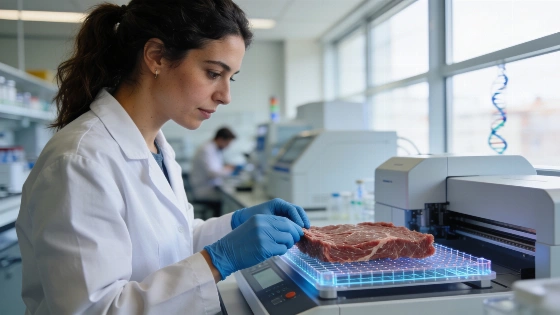
A new 3D spatial transcriptomics platform at CNAG in Barcelona lets researchers study gene activity in tumours while keeping tissue structure intact. The first project focuses on colorectal cancer.
Spain has installed its first three-dimensional spatial transcriptomics platform at the Centro Nacional de Análisis Genómico (CNAG) in Barcelona. Only two other labs in Europe have the technology. It lets scientists map gene activity inside intact tissue samples while preserving their original 3D structure. The first project will examine colorectal cancer, still one of the most common and aggressive tumours worldwide. The platform, Pyxa, is made by Stellaromics and is now up and running at CNAG, EFE reports.
Earlier genomic tools could show which genes were active and in which cells, but not where those cells were located within the tissue. The new system pinpoints each cell, allowing researchers to see how cells interact and how their surroundings affect tumour growth. That brings analysis closer to real biological conditions, a basic step in understanding how tumours develop and interact with healthy tissue. EFE and CNAG confirm this is the first time a 3D spatial transcriptomics platform has been used in Spain, with support from the Ministry of Science and the Generalitat de Catalunya.
The CNAG platform can process tissue slices up to 20 times thicker than before. Researchers can so study a wider range of samples, including primary tumours and metastatic lesions, while preserving their 3D context. Healthy tissue is also among the samples they can examine. Anna Pascual Reguant, who leads the Spatial Genomics Team at CNAG, says the technology gives researchers a close-up view of tumour development. It captures gene activation and RNA production in much greater detail, while also tracking protein translation. She says this detail is impressive to finding new biomarkers and developing more personalised therapies.
The platform also includes spatial translatomics, which maps ribosomes and tracks how RNA messages turn into proteins. Combining these layers of information gives scientists a fuller picture of the biological processes behind disease. The first project focuses on colorectal cancer, but the technology could also be used to study immune disorders and chronic inflammatory diseases. EFE reports that the first research project using the platform is already underway and targets colorectal cancer, one of the most frequent and aggressive tumour types.
The installation cost nearly €500,000 and was funded by the European Union’s Next Generation programme as part of Spain’s Recovery, Change and Ability to recover Plan. Backed by the Ministry of Science, New idea and Universities and the Generalitat de Catalunya, CNAG will make the platform available to hospitals and research centres across Spain. Creating 3D molecular maps of tissue could speed up the discovery of new biomarkers and, over time, help develop more effective and personalised treatments.
Spain’s move to 3D spatial transcriptomics marks a shift in research priorities. Looking beyond flat tissue analysis allows Spanish scientists to study the complexity of cellular architecture. The investment aims to narrow the gap between lab models and the unpredictable reality of human disease. CNAG’s new platform puts Spain in a stronger position to compete for discoveries that could change how tumours are understood and treated, with practical benefits for patients and the national health system.