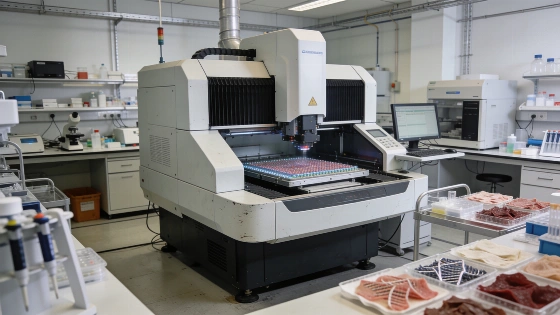
Spain has installed its first 3D spatial transcriptomics platform at CNAG in Barcelona. The technology allows researchers to study gene activity in real tissue environments. Its first project targets colorectal cancer, with the aim of improving diagnostics and therapies.
Spain has brought its first 3D spatial transcriptomics platform to the Centro Nacional de Análisis Genómico (CNAG) in Barcelona. Developed by Pyxa (Stellaromics), the system is one of only three in Europe and is already being used to study colorectal cancer, a common and aggressive tumor. The technology arrived on September 15, 2026. The Spanish news agency EFE reports that the installation puts Spain among the few European centers with this capability.
The platform preserves the three-dimensional structure of tissue samples, letting scientists see gene activity in its actual location within organs. Researchers can map how each cell's position in a tumor or healthy tissue affects its behavior and role in disease. The system can analyze tissue slices up to 20 times thicker than before, helping scientists understand how cancer spreads and how healthy cells interact with their surroundings. EFE notes that this is especially useful for studying tumor structure and its nearby microenvironment.
The Pyxa platform at CNAG cost approximately 500,000 euros, funded through the EU's Next Generation program and Spain's Plan de Recuperación, Cambio y Resiliencia.
The first focus is colorectal cancer, though the technology has broader uses. By preserving the original structure of tissues, it enables detailed studies of how genes activate and RNA is produced, as well as how proteins are translated in their natural context. Scientists can create precise maps of ribosomes and track how genetic instructions become proteins, a process central to health and disease. EFE reports that the first project is underway and targets colorectal cancer, described as one of the most frequent and aggressive tumor types.
Dr. Anna Pascual Reguant, who leads the Spatial Genomics team at CNAG, compares the new approach to putting on '3D glasses' to watch tumors develop. The platform is also expected to accelerate research into immune disorders and chronic inflammatory diseases by revealing cell mechanisms hidden in two-dimensional analyses. EFE reports that CNAG sees potential for studying autoimmune and inflammatory diseases, since 3D analysis lets researchers observe cell interactions within tissue in its original structure.
This investment of nearly 500,000 euros, funded by the European Union's Next Generation program under the Plan de Recuperación, Cambio y Resiliencia, gives Spanish hospitals and research centers access to a tool that may help identify new biomarkers. It may also improve patient classification and support the development of more effective, personalized therapies.
Stellaromics has confirmed adoption of the Pyxa platform in Spain and at leading research institutions across the US and Europe, pointing to a broader international rollout beyond a single local installation.
For Spain, the technology represents more than an equipment upgrade. It reflects a commitment to advanced research and an effort to compete with top European centers. As results from the colorectal cancer project emerge, the basic question is how quickly the findings lead to better diagnostics and treatments. CNAG's move sets a new standard for biomedical research in Spain, with the goal of taking a leading role in medical new idea.