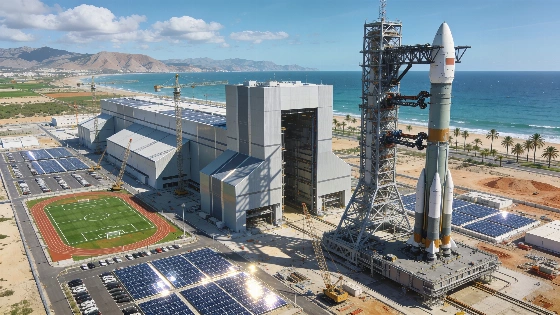
A new industrial complex in Elche is set to transform Spain’s role in the global space industry. Backed by €65 million in private investment, the site will mass-produce the MIURA 5 orbital launcher and create thousands of jobs, marking a decisive step for Spanish aerospace.
PLD Space has secured a green light for one of Spain’s most significant industrial ventures: a sprawling aerospace campus in Elche dedicated to the serial production of the MIURA 5 orbital launcher. With an initial investment of €65 million, the project is designed to move Spain from prototype launches to full-scale manufacturing, positioning the country as a serious contender in the international space sector.
The future complex, located in Les Vallongues within the Porta d’Elx development, will cover 720,821 square meters. According to plans, construction of the first phase is expected to begin in early 2027, pending final permits from the Generalitat Valenciana, which is processing the initiative as a Project of Regional Interest. The initial build is projected to take between 22 and 24 months.
Industrial Scale and Facilities
At the heart of the campus will be a 95,130-square-meter production hall, purpose-built for the assembly, integration, and storage of large aerospace vehicles. This will be complemented by a 26,500-square-meter technical building housing advanced machinery, energy systems, and precision equipment. Nearly 25,000 square meters of office space will bring together engineering, R&D, logistics, and administration, all within close reach of Alicante-Elche airport and major transport links.
The project is structured in three phases, with future expansions set to increase industrial capacity, add new office areas, and introduce a temporary residence for employees. Accommodation will range from hotel-style rooms to bungalows, reflecting the company’s aim to attract and retain top talent.
Workforce and Community Features
PLD Space’s vision extends beyond manufacturing. The campus will feature a first-cycle nursery for employees’ children, with four classrooms for ages one to three, an outdoor play area, dining facilities, and a multipurpose room for meetings and family support. Sports amenities will include paddle and pickleball courts, crossfit and calisthenics zones, locker rooms, a café, and landscaped green spaces. A solar-equipped parking area will provide over 1,600 spaces, underlining the project’s commitment to sustainability.
Economic Impact and Job Creation
The first phase alone is expected to generate 713 direct jobs during construction, with an estimated 1,700 additional positions created in logistics, transport, services, and hospitality. Once operational, the campus could support between 500 and 2,000 direct jobs, plus up to 4,000 indirect roles across the aerospace supply chain. These figures reflect the full development scenario and are not tied to current recruitment drives.
PLD Space, which reported a workforce of 460 in March, plans to hire around 90 more professionals in 2026. The company is actively collaborating with vocational training centers to source specialists in metalwork, welding, composite materials, and quality control.
International Backing and Strategic Partnerships
The project’s momentum is reinforced by a €180 million funding round led by Mitsubishi Electric, which contributed €50 million. This partnership gives Mitsubishi priority access to MIURA 5 launch services for its small satellite projects in Japan and other Asian markets. The Elche facility will integrate Spain into the global satellite launch network and strengthen the nation’s capacity to produce orbital vehicles domestically.
Spain’s push into the space sector mirrors broader international trends in advanced technology and energy innovation. For example, a recent breakthrough in nuclear battery technology by a Chinese research team, as detailed in this report on next-generation power sources, highlights the rapid pace of change in the global tech landscape.
As the Elche campus moves forward, its scale and ambition signal a new era for Spanish industry—one where the country is not just a participant, but a builder of the future of space exploration.