A Chinese research team has introduced a lithium-free nuclear battery designed to operate for thousands of years without recharging. While its output is modest, the technology could transform power supply for remote sensors and scientific equipment.
On July 6, 2026, in Lanzhou, Chinese scientists revealed a battery that challenges conventional ideas about longevity and maintenance. The Qianjiyuan Tianshu, developed by researchers at Northwest Normal University and Gansu Zhulong Technology, is a nuclear battery that forgoes lithium entirely, instead harnessing the radioactive decay of carbon-14 to produce electricity.
Unlike traditional lithium batteries, which store energy chemically and require regular recharging, the Qianjiyuan Tianshu generates a continuous trickle of power as carbon-14 atoms naturally break down. This process emits beta particles, which are captured by a silicon carbide transducer—a semiconductor that converts the energy into usable electricity. The result is a device that, in theory, could function for thousands of years, limited mainly by the durability of its non-radioactive components.
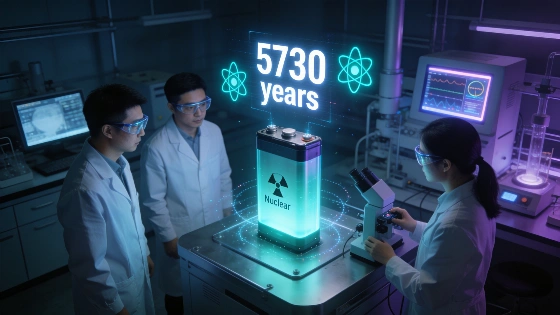
The headline-grabbing figure—5,730 years—refers to the half-life of carbon-14, the time it takes for half of the isotope to decay. While the battery will not suddenly stop working after this period, its output will gradually diminish as the radioactive material is depleted. The real-world lifespan will also depend on how well the encapsulation, electronics, and connections withstand the test of time.
Limited Power, Unique Applications
With a maximum output of just 1.13 microwatts, the Qianjiyuan Tianshu is not intended for smartphones, electric vehicles, or household appliances. Its true value lies in powering devices that require minimal energy but must operate reliably for decades or even centuries—such as remote sensors, scientific instruments, or equipment deployed in extreme environments where maintenance is nearly impossible.
The battery's compact size—16.8 cubic centimeters—and its use of 129 millicuries of carbon-14 make it suitable for specialized roles. According to the developers, it delivers a short-circuit current of 0.713 microamperes and an open-circuit voltage of 2.06 volts. These specifications rule out high-consumption electronics but open doors for applications in deep space exploration, polar research, underwater monitoring, and certain medical devices, provided regulatory hurdles are cleared.
Technological Leap and Safety Considerations
This new battery builds on the earlier Zhulong-1 prototype, but with significant improvements. The team reports that the amount of radioactive material has been reduced to just 22% of the previous design, while the short-circuit current has increased 2.5 times and maximum power is up by a factor of 2.6. The effective volume has shrunk by 83%, and volumetric power density has soared 15.5 times, marking a substantial leap in efficiency and miniaturization.
All key components, including the silicon carbide transducer, are produced using Chinese technology, reflecting a strategic push to reduce reliance on foreign suppliers and enable future industrial-scale manufacturing of long-life power sources.
Not a Commercial Guarantee
While the theoretical lifespan of 5,730 years is striking, it is not a commercial warranty. The figure simply describes the decay rate of carbon-14, not the expected operational life of the battery as a whole. Over centuries, materials degrade, seals fail, and electronics age. The battery's true longevity will depend on advances in materials science and engineering, as well as rigorous testing and certification.
For now, the Qianjiyuan Tianshu represents a promising step toward ultra-long-lasting power for niche applications. As the technology matures, it could help solve challenges in fields where changing a battery is impractical or impossible. The concept of energy sources that outlast civilizations may sound futuristic, but the groundwork is being laid today.
Innovations in energy storage are not limited to nuclear technology. For those seeking practical ways to manage heat and power at home, simple solutions—like using a damp towel to cool a room—can also make a difference, as explored in this guide to beating the heat without air conditioning.