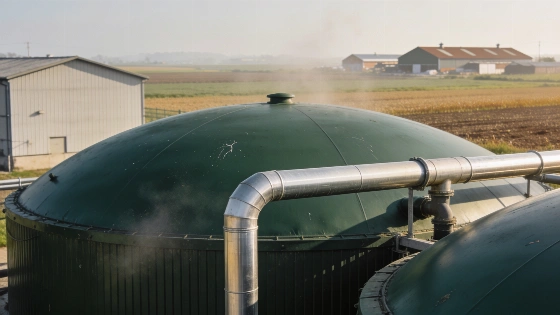
Spain is preparing for a sharp rise in renewable gas projects. Castilla y León could host 15% of the planned biomethane plants as investors test a market that is still taking shape.
Tresca Ingeniería estimates that only four or five biomethane plants are now under construction in Spain. Planned projects could reach 400 facilities, with investment of around €4 billion.
The market is still young.
A project in León financed by ING is expected to begin operating in the first quarter of 2027. The €42.5 million facility is designed to produce 125 GWh of biomethane a year while also capturing CO₂.
Energy and fuel prices are rising again. That is pushing renewable gas higher on the investment agenda.
Avebiom president Javier Díaz says biogas and biomethane offer a strong opportunity for Castilla y León and for Spain as a whole. Biomethane can use existing natural gas networks. Homes and factories would not need changes to their installations.
Castilla y León has one clear advantage. Agricultural and livestock activity can supply the raw material needed to make biogas. Tresca Ingeniería estimates that the region could host about 15% of the plants planned across Spain.
The question is not only how much energy can be made. It is also where that energy is produced and who benefits from it.
At the opening of the Congreso Internacional de Bioenergía in Valladolid, Díaz pointed to Spain's more than 100,000 kilometres of gas networks. Those networks already connect industry and households. Biomethane could use them and reduce reliance on imported fossil fuels.
Díaz also said production could keep more economic value and jobs in Spain.
Industry estimates place Castilla y León’s biomethane potential at 37.78 TWh per year, or 23.2% of Spain’s total estimated potential. The region already has four plants injecting biomethane into the gas network, while the regional administration reports that 20 projects have received environmental approval and another 107 are under review, including 55 in public consultation.
The figures from Castilla y León show why the region is attracting attention. It already has four plants injecting biomethane into the gas network. The regional administration says 20 projects have received environmental approval, while another 107 remain under review.
Those 107 projects include 55 in public consultation. Permits will matter.
The sixth renewable gas exhibition and the nineteenth edition of the Congreso Internacional de Bioenergía are taking place over two days at the Feria de Valladolid. The event has 275 exhibitors. Foreign companies account for 60% of them.
Organisers expect more than 4,000 professional visitors from over 25 countries. More than 25 countries are represented. Project finance, regulation and the connection of new plants to the gas grid are among the topics under discussion.
Household and business costs are also under pressure, as described in an earlier housing report.
Jorge Villeta, Tresca Ingeniería's director of Business and Corporate Development, calls the Spanish sector incipient. He also says investors are showing clear interest. His estimate of the construction pipeline points to a wide gap between the few plants now being built and the much larger number of projects under consideration.
That gap is visible in the permitting figures. The number of projects still under examination is much higher than the number that already has environmental approval, according to figures cited by the Castilla y León administration.
Network access and investment terms will matter as much as the supply of agricultural and livestock feedstock. The same applies to the time needed to move a project from approval to construction.
Joaquín Antonio Pino, the councillor for Agriculture, Livestock, Rural Environment and Environmental Policy, said the transition cannot be carried out against the countryside. He called for biogas and biomethane plants to be profitable for rural areas and useful to farmers, livestock owners and village residents.
His position matches the regional policy argument that agricultural and livestock waste can produce energy and fertiliser. It can also bring extra income to local areas.
Regulation now sits at the centre of the investment case. Industry talks involving European and Spanish authorities have covered possible biomethane quotas, access to the gas network and funding for infrastructure upgrades.
Sedigas and other sector participants have described those issues as practical conditions for moving projects from environmental approval to construction and grid injection.
Castilla y León has the raw material, existing gas networks and a projected €4 billion pipeline. The rural test is clear.
Projects must bring income, jobs and local tax value to the communities that supply their raw materials. Biomethane has moved beyond a technology promise. Its credibility will depend on what reaches the countryside.