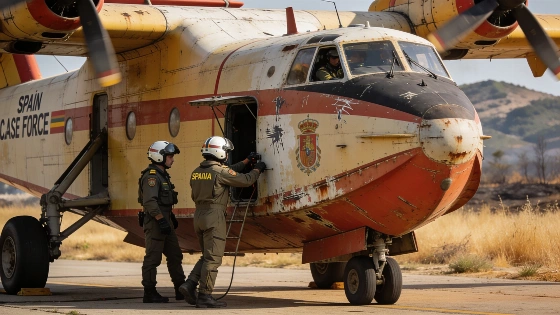
Spain’s main firefighting aircraft remain outdated, with most purchased decades ago. Only one of 14 was acquired by the PP. New planes are on order, but the first will not arrive until 2028.
Spain’s main fleet of firefighting aircraft, operated by the Air and Space Force, is under scrutiny as wildfires intensify and political debate grows over responsibility for outdated equipment. Despite criticism from the Partido Popular (PP) about the lack of modernization, official records show that only one of the 14 Canadair amphibious planes currently in service was purchased during a PP government. The rest were acquired under previous administrations, mostly led by the PSOE.
The PP, which controls most regional governments responsible for wildfire prevention and response, has accused the central government of failing to update the fleet. Spokesperson Ester Muñoz recently described the aircraft as “obsolete” and claimed no progress had been made since 2022. However, data reveals that the last addition to the fleet came in 2013, during Mariano Rajoy’s term, while the majority of the planes date back to the late 1980s and early 1990s, with some even older models retired only last year.
Of the 14 Canadair aircraft currently operational, 11 belong to the Ministry for Ecological Transition and Demographic Challenge (Miteco), and three to the Ministry of Defence. Ten of these were purchased under Felipe González’s government, with three more added during José Luis Rodríguez Zapatero’s tenure. The most recent, a CL415 model, was bought in 2013 by the Rajoy government. Efforts to renew the fleet have faced obstacles, as the manufacturer De Havilland required a minimum order of 20 planes to restart production. Spain, in coordination with France, Italy, Greece, Portugal, and Croatia, placed a joint order, resulting in seven new DHC-515 aircraft for Spain at a cost of €375 million. The first delivery is not expected until 2028, with the last arriving in 2031.
Plans to upgrade the avionics of ten CL215T aircraft were abandoned this July after the selected contractor raised the price and a legal challenge forced the cancellation of the contract. As a result, the government is likely to phase out these planes as the new models arrive, missing the opportunity to use EU recovery funds for modernization. The current operational commitment is to provide 10 aircraft for the summer wildfire campaign, but due to incidents such as bird strikes, only seven are currently flying. Military sources consider this an acceptable level of readiness, though they acknowledge that newer planes would improve reliability.
Alongside the main fleet, Miteco deploys 15 additional planes and 31 helicopters for firefighting. The Ministry of Defence has also explored adapting A400M transport aircraft for fire suppression, but logistical and geographic challenges make this option impractical for Spain’s rugged terrain. Until the new DHC-515s arrive, authorities expect to continue relying on the existing fleet, unless private aircraft are leased to fill gaps.
Recent wildfires have highlighted the strain on Spain’s aerial firefighting resources. As reported in coverage of mass evacuations in Madrid and Ávila, the combination of extreme weather and limited aircraft availability has complicated emergency response efforts.
Spain’s reliance on aging firefighting planes is not unique in Europe. Many countries face similar challenges, as the Canadair series has long been the backbone of aerial firefighting across the Mediterranean. The DHC-515, designed to replace older models, promises greater water capacity and advanced navigation systems, including night vision. However, the long production timeline means that, for now, Spain must manage with a fleet where most aircraft are between 36 and 40 years old. The situation underscores the complexity of renewing specialized state assets and the impact of procurement delays on public safety during increasingly severe wildfire seasons.