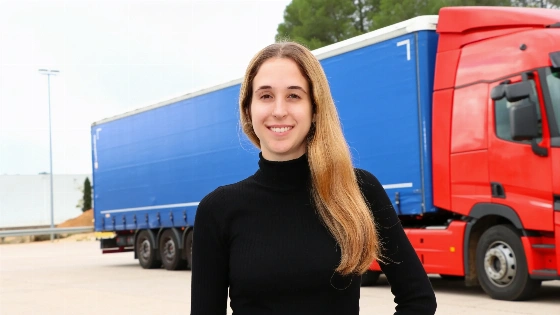
At 22, Andrea García Cano has become a impressive figure in Spain’s transport sector, recognized as the country’s youngest female truck driver. Her path began with a childhood fascination with vehicles and long-distance travel, not a family tradition. That interest led her to pursue a career in heavy transport as soon as she reached the legal driving age.
After obtaining licenses for rigid trucks and trailers, Andrea moved quickly from operating forklifts in a logistics warehouse to making deliveries for a major supermarket chain. In basic Barcelona’s dense traffic, she faced the daily challenge of maneuvering a large vehicle through crowded streets. Cars and pedestrians filled the roads, with motorcycles adding to the unpredictability. She says daytime driving offers better visibility but demands constant vigilance because of the traffic volume and the need to anticipate other road users.
“I prefer driving during the day, it’s calmer, but you have to be even more careful,” Andrea explains. Urban routes are stressful because congestion forces her to divide her attention among hazards, especially in busy city centers. Daylight brings its own dangers: sudden braking and complex maneuvers can turn distractions from other drivers into risky situations.
Night driving, by contrast, means clearer roads but brings different risks. Andrea warns that fatigue and drowsiness pose the basic threats after long hours behind the wheel, especially in heavy vehicles. Reduced visibility cuts reaction time when unexpected obstacles appear, including animals or breakdowns. Dirección General de Tráfico guidance, cited by El País Motor, says night driving can impair visual capacity and distance perception, while glare can delay the eyes’ recovery. The DGT recommends regular schedules for meals and rest, with around eight hours of sleep. Andrea relies on strict rest routines and music to stay alert, and says night shifts demand greater discipline and preparation.
Andrea now works regional and long-haul routes, including overnight trailer exchanges between Catalonia and Zaragoza. In interviews and on digital platforms, she aims to show the realities of the profession and draw attention to structural problems facing drivers. She is particularly concerned about low wages and rigid digital tachograph rules, which can penalize drivers for minor, necessary movements during rest breaks at service stations.
Despite the dangers of driving by day and night, Andrea values the independence and freedom her job offers, qualities she finds lacking in more static roles. She sees her time on the road as a stepping stone. Her long-term goal is to complete advanced studies in Transport and Logistics before moving into traffic management at her company’s headquarters. She also hopes to secure a more stable schedule and start a family.
Her story reflects wider changes in European trucking, where new technology and shifting demographics are reshaping the profession. The introduction of advanced models such as the Volvo FH Aero, covered in recent industry reports, signals a push for greater efficiency and safety. Those developments could affect the next generation of drivers.
Women remain a small minority in the profession. Figures attributed to the International Road Transport Union and reported by El Español put women at about 2% of Spain’s truck drivers, roughly 5,000 people. Around 25,000 women hold the relevant entitlement to lead trucks. A separate figure reported by El Confidencial Digital, citing Spain’s Ministry of Transport, says women accounted for approximately 11% of truck-driving permits issued annually in March 2025. The figures cover different groups: permits issued in a year do not equal the share of women currently working as professional drivers.
The sector also faces an age imbalance. Randstad Research figures cited by Autopos indicate that 64% of professionals in driving and machinery-handling occupations are at least 45 years old. The figures cover a broader occupational group than truck drivers alone, but point to workforce and recruitment challenges in road transport. Against that backdrop, Andrea’s experience highlights opportunities and persistent barriers for women entering the industry, from daily life on the road to concerns about pay and working conditions. Her determination reflects the changing field of Spanish logistics and the ability to recover required to thrive in the profession.