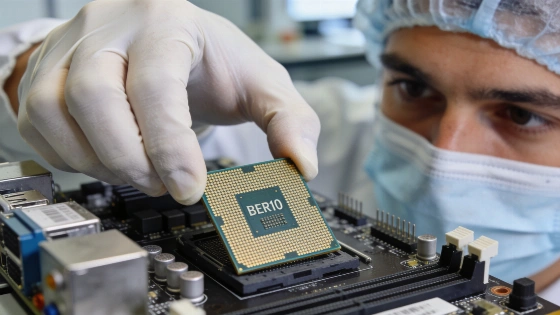
A Spanish-designed RISC-V chip, BER10, is now available for validation in supercomputing and data center projects. Developed by Openchip, this 64-bit processor aims to boost Europe’s independence in advanced silicon and support future AI accelerators.
On July 30, 2026, Openchip introduced BER10, a 64-bit processor developed in Spain and built on the open RISC-V architecture. After two and a half years of engineering, the chip is now ready for companies and research centers to test and validate their high-performance computing projects.
BER10 is not just a prototype. The silicon is fully functional, capable of running a complete Linux operating system, and leverages cutting-edge Gate-All-Around technology at under 2 nanometers. This positions it as a foundation for future accelerators targeting artificial intelligence and supercomputing workloads.
Advanced Architecture
The processor features four high-performance cores that support out-of-order execution and simultaneous operations, allowing it to handle complex tasks efficiently. This architecture enables the chip to keep processing while slower operations are still pending, a crucial advantage for demanding server and data center environments.
One of BER10’s standout components is its vector unit, designed to accelerate parallel calculations. Openchip has tailored this for AI, image processing, and scientific computing—fields where rapid, large-scale data handling is essential. The chip also integrates fast multi-channel memory and high-speed PCIe and AXI connections, ensuring compatibility with the hardware ecosystems found in modern data centers.
While Openchip has not yet released details on clock speeds, power consumption, pricing, or direct performance comparisons, the company emphasizes that BER10 is ready for real-world validation and software development.
Open Standards, European Control
RISC-V, the open instruction set architecture at the heart of BER10, allows companies to design processors without paying licensing fees. This flexibility lets European firms and institutions create chips tailored to their specific needs, reducing reliance on architectures controlled by foreign suppliers.
Although RISC-V is open, manufacturers can choose to keep certain design elements proprietary. Openchip’s approach combines open standards with protected innovations, aiming to balance transparency and competitive advantage.
The company argues that this model strengthens Europe’s technological sovereignty, especially for sectors like government, banking, healthcare, and critical infrastructure, where control over hardware is increasingly important.
Ready for Deployment
Unlike many projects that remain in simulation, BER10 is a physical, working chip. Partner companies and computing centers can now use it to develop software, test workloads, and ensure compatibility with the RISC-V ecosystem before the next generation of products arrives.
Openchip CEO Cesc Guim highlighted the significance of this milestone, stating that BER10 demonstrates Europe’s ability to produce advanced silicon based on open standards. The chip will serve as a platform for developing new RISC-V accelerators focused on AI, supercomputing, and data center applications.
As data infrastructure expands, so do debates over land use and resource consumption. Recent cases, such as landowners rejecting lucrative offers for data center construction, reflect the growing impact of this sector on local communities.
Major Public Investment
On June 29, 2026, Spain’s Council of Ministers approved an investment of over €115 million in Openchip through the Sociedad Española para la Transformación Tecnológica (SETT). This funding aims to accelerate the design and commercialization of high-performance, energy-efficient chips for AI and supercomputing.
In total, Openchip has received around €261 million in public support, including €111 million from the PERTE Chip initiative and €35 million from the Generalitat of Catalonia. Founded in 2021 by the Barcelona Supercomputing Center and GTD Software Engineering, the company now employs about 300 people, with public investment tied to job creation and the development of a European semiconductor industry.
According to Openchip’s official announcement, BER10 has moved beyond the design phase and is now a tangible product capable of running real software. However, the company has not yet disclosed when large-scale commercial production will begin or which manufacturers will be involved in future processor fabrication.
As Europe seeks greater independence in advanced technology, BER10 marks a significant step toward building a homegrown ecosystem for high-performance computing and artificial intelligence.