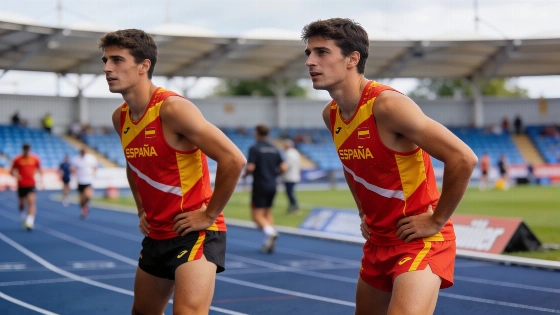
Spain enters a decisive day at the Birmingham athletics championships. Multiple finals and medal opportunities are at stake. The marathon and relay teams headline a packed schedule for Spanish athletes.
Spain faces a pivotal day at the European Athletics Championships in Birmingham, with several medal chances and high-profile finals on the agenda. The national team, led by coach Pepe Peiró, has already secured six medals and 22 finalist positions, but the focus now shifts to a series of events where Spanish athletes are seen as strong contenders for the podium.
The morning session is dominated by the marathon, where both the men's and women's teams are considered among the favorites. The women's squad features Ester Navarrete, Fátima Ouhaddou, Carolina Robles, and Meritxell Soler, while the men's lineup includes Carlos Mayo, Jorge Blanco, Ibrahim Chakir, Ilias Fifa, Jorge González, and Fernando Carro. Team medals will be determined by the combined times of the top three finishers from each country, adding strategic depth to the race. According to Carro, the group is motivated and ready to compete at the highest level.
Later in the day, attention turns to the women's javelin final, where Yulenmis Aguilar enters with realistic hopes of a medal. Several top-ranked competitors failed to reach the final, opening the field for Aguilar, who is currently ranked fifth in Europe for 2026. She remains confident about her chances, aiming to deliver her best performance in Birmingham.
Fátima Diame will also compete in the women's long jump final. Despite a modest qualifying round, where she placed 11th with a jump of 6.65 meters, Diame—already a double world indoor bronze medalist—will look to improve and challenge for a top spot. The mixed 4x100 relay final follows, offering another opportunity for Spain after technical issues prevented the gender-specific relay teams from advancing earlier in the competition.
In the men's 3,000-meter steeplechase, Dani Arce, who previously won bronze at the 2022 Munich championships, is determined to make an impact after missing out in Rome due to illness. He is joined by Alejandro Quijada, with both athletes aiming to capitalize on their current form and the dynamics of the race, regardless of pace.
The day concludes with the women's 4x400 relay final, where the 'Golden Bubbles'—Paula Sevilla, Ana Prieto, Rocío Arroyo, and Blanca Hervás—are expected to represent Spain. The final lineup will be confirmed just before the race. The team emphasizes their unity and depth, viewing themselves as a serious threat to favorites such as Great Britain, Poland, and the Netherlands.
Spain's recent success in Birmingham has drawn attention, especially after standout performances in race walking and the marathon, as highlighted in coverage of earlier Spanish achievements at these championships. The current momentum reflects the depth and ambition of the Spanish athletics program, with athletes and coaches alike expressing optimism for further podium finishes.
For context, the European Athletics Championships serve as a major stage for national teams to demonstrate their strength ahead of global competitions. Spain's approach, focusing on both individual and team events, has proven effective in recent years. The structure of team scoring in the marathon, for example, rewards collective performance rather than just individual placements, which can benefit countries with strong depth. The relay events, particularly the mixed 4x100 and women's 4x400, have become increasingly competitive, with technical execution and team chemistry often making the difference. As the championships progress, Spain's results in Birmingham may influence selection and preparation strategies for future international events.