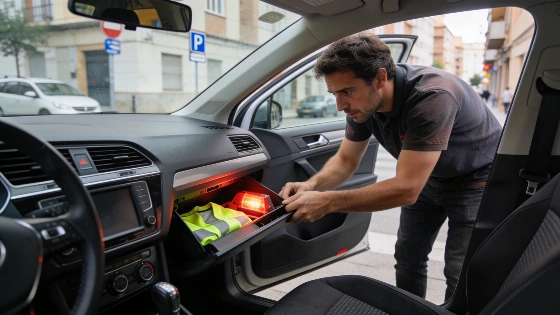
The DGT has ended confusion over first aid kits in Spanish vehicles. Drivers cannot be fined for not carrying one, but strict rules remain for other mandatory items. Here’s what every motorist needs to know.
For years, Spanish drivers have wondered if a first aid kit is required in their cars. The Dirección General de Tráfico (DGT) has now made it clear: you do not need to carry a first aid kit, and there are no fines for leaving it out.
This settles a long-running debate, especially since some European countries do require first aid kits. In Spain, though, the law is specific. The official list of mandatory items appears in the Reglamento General de Vehículos, annex XII. First aid kits are not included.
From 2026, Spain requires a connected V-16 emergency beacon instead of traditional warning triangles for roadside incidents.
So, what does the law actually require? Every car, van, and light goods vehicle (up to 3,500 kg) must have a V-16 emergency warning light, a high-visibility reflective vest that meets Spanish and EU standards, and either a full-size spare wheel, a temporary-use wheel with the right tools, or an approved alternative for mobility. The reflective vest is compulsory: drivers must wear it when stepping onto the road or hard shoulder outside cities, and it must meet technical standards. According to Motor EL PAÍS, these rules are confirmed by the DGT and are enforced by Spanish authorities.
By contrast, a first aid kit—while useful for minor injuries—remains optional. The DGT recognizes its value, especially for treating small wounds while waiting for emergency services, but does not require it by law. This is different from countries like Germany or France, where missing a kit can mean a fine. As EL PAÍS notes, drivers heading outside Spain should check local rules, since requirements vary across the EU.
Rules for documents have also changed. Drivers must have their license, the vehicle’s technical inspection card, and the circulation permit. These can now be shown digitally using the miDGT app, as long as the driver is in Spain. Proof of insurance or payment receipts are no longer needed, since police can check coverage electronically. This digital shift is part of the DGT’s broader modernization of traffic regulations.
Failure to carry a spare wheel or an approved repair kit can result in fines of up to 200 euros, and in some cases, the vehicle may even be detained until compliance is ensured. This penalty is actively enforced by the Guardia Civil during roadside checks, reflecting the strict approach to essential safety equipment.
This update fits into a series of recent changes in Spanish traffic law. As reported earlier, Spain has tightened rules for vulnerable road users and introduced new safety measures, but the first aid kit is still not required.
In practice, the DGT’s position means drivers face no penalties for not carrying a first aid kit. The focus is on visibility, signaling, and mobility—areas where the rules are enforced. For drivers, the advice is simple: check your vest, warning light, and spare wheel. The first aid kit is up to you. Unless Spain decides to follow stricter European standards, this is unlikely to change.