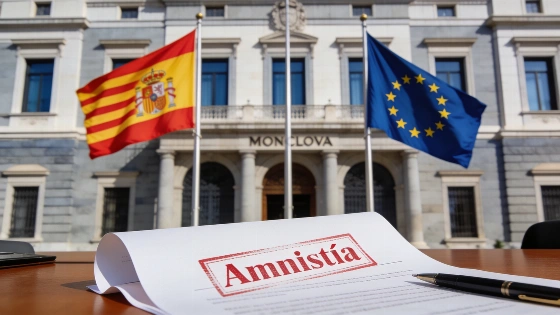
Spain’s amnesty law has received support from the EU’s top court. The government insists the measure is constitutional and aligns with European law. The ruling addresses tensions over Catalonia’s independence process.
The Spanish government has declared the country’s amnesty law fully compatible with both the Constitution and European legal standards, following a key ruling from the Tribunal de Justicia de la Unión Europea (TJUE). Minister Félix Bolaños, responsible for the Presidency, Justice and Relations with the Cortes, emphasized that the court’s decision removes any lingering doubts about the legality of the measure. Speaking at La Moncloa, Bolaños underlined that the law, approved by parliament in June 2024, was thoroughly vetted and passed all constitutional checks before its adoption.
Bolaños highlighted that the TJUE’s position confirms the amnesty law as a legitimate tool for easing political and social conflict. He pointed out that the measure was designed to reduce institutional and political tensions stemming from the Catalan independence movement, aiming to create a climate of reconciliation. According to the minister, the European court’s endorsement brings an end to a debate that, in his view, was often driven more by emotion than by legal arguments.
The government’s stance comes after months of heated discussion over the scope and implications of the amnesty, which was introduced to address the fallout from the 2017 Catalonia independence referendum and subsequent legal actions. The law’s passage through Congress was marked by intense scrutiny and political division, but officials now stress that the process was transparent and in line with both national and European frameworks.
In the broader context, the issue of judicial independence and political influence has remained a recurring theme in Spain. Recent controversies, such as the exposure of private communications involving former Prime Minister Zapatero, have fueled debate about the boundaries between politics and the judiciary. For example, the government’s reaction to the leak of sensitive data and messages was covered in detail in a report on the fallout from the Zapatero data breach, highlighting ongoing concerns about privacy and legal safeguards.
Amnesty laws have a long history in Europe, often used to resolve political crises or facilitate national reconciliation after periods of unrest. In Spain, the current measure is seen as part of a broader effort to stabilize relations between Madrid and Catalonia, following years of legal battles and political standoffs. The TJUE’s ruling is expected to influence future debates on the use of amnesty in similar contexts, reinforcing the principle that such laws can be compatible with both domestic and European legal systems when properly framed and justified.