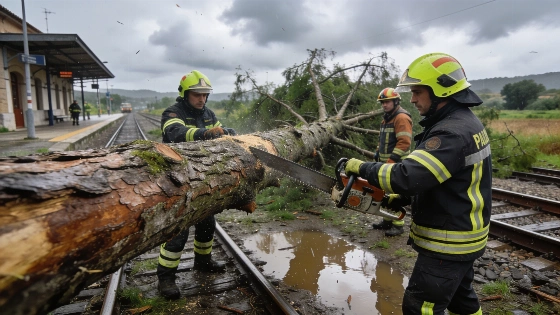
Heavy rain and strong winds have led to fallen trees, flooding, and major transport disruptions in Catalonia. Emergency services responded to dozens of incidents. Authorities urge caution near rivers and flood-prone areas.
Severe storms swept through Catalonia on Thursday, triggering widespread disruption as emergency services responded to dozens of incidents caused by intense rain and wind. The region saw fallen trees, flooded streets, and blocked roads, with the R3 Rodalies train line between Vic (Barcelona) and Ripoll (Girona) forced to suspend service after a tree collapsed onto the tracks.
Between midday and 6 p.m., firefighters received 51 calls for assistance, mainly in Girona province and central Catalonia. Most incidents involved trees falling onto public roads and water flooding ground floors of buildings. The adverse weather also led to a rockslide on the N-145 near Valls de Valira (Lleida), causing traffic jams up to four kilometers in both directions before the road was cleared by early evening.
President Salvador Illa called for maximum caution, especially for those traveling during the storm. He emphasized the importance of following emergency instructions, staying away from rivers, streams, and ravines, and avoiding parking in areas prone to flooding. The Civil Protection agency maintained the Inuncat emergency plan, warning that rainfall could exceed 40 liters per square meter across much of the territory.
As the storm front moved from the Pyrenees toward the coasts of Girona, Barcelona, and Tarragona, authorities reported hail and strong gusts complicating driving conditions. Visibility was particularly poor on the C-25 between Rajadell and Fonollosa, prompting further warnings for motorists to exercise extreme caution.
Transport disruptions and emergency alerts have become more frequent in recent years, reflecting a broader pattern of severe weather events affecting Spain’s infrastructure. For context, regional responses to crises have previously drawn attention, such as when political tensions in Catalonia escalated following judicial decisions. While Thursday’s storms did not result in reported injuries, the scale of the response highlights the ongoing challenges posed by extreme weather in the region.
According to meteorological data, Catalonia is increasingly vulnerable to sudden, intense rainfall episodes, which can overwhelm drainage systems and disrupt daily life. The Inuncat plan, regularly activated during such events, coordinates emergency resources and public communication. Residents are advised to monitor official updates and avoid unnecessary travel during alerts. The current episode was expected to subside by midnight, but authorities remain vigilant for further developments as weather patterns continue to shift unpredictably across Spain.