
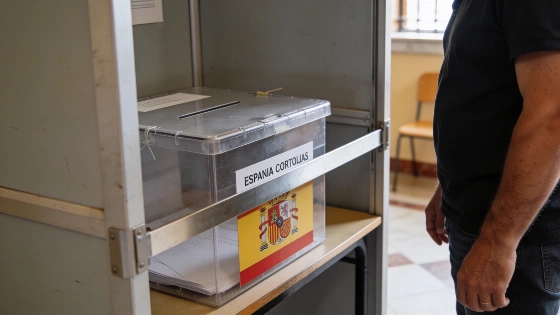
Spain’s Supreme Court has refused to lift the suspension affecting an estimated 163,020 beneficiaries of the law of grandchildren. Those affected may have to challenge the ruling again before seeking constitutional protection.
On 12 October, the Supreme Court rejected the State Attorney’s Office request to lift the precautionary measure.
The general election is set for 29 November 2026. The court accepted that the approaching vote was a relevant new circumstance, but said it did not remove the risk of an inaccurate or irregular register of overseas voters, known as the CERA. The suspension covers an estimated 163,020 people who obtained Spanish nationality through the exile provision of the law of grandchildren.
People’s Party leader Alberto Núñez Feijóo welcomed the measure, saying it would prevent ‘irresponsibility’ in the formation of the overseas electorate.
The judges also faulted the government’s legal team for failing to provide a reliable account of how far the original order had been implemented. Without that evidence, the court said, the reasons for the suspension remained. It rejected the claim that the approaching 29-N made compliance practically impossible: an administration cannot rely on obstacles caused by its own failure to carry out a judicial order.
The ruling passed by five votes to one. In a 45-page decision dated 12 October, the Fourth Section clarified that some applicants can still vote if they prove they acquired nationality as genuine descendants of people exiled for reasons covered by Spain’s Law 20/2022 on Democratic Memory. The qualifying reasons include political or ideological persecution. The law also covers religious persecution and persecution tied to sexual identity.
The suspension applies to people whose applications to join the CERA remain incomplete. It also covers citizens already registered there under the disputed basis. EFE and El Periódico report that the dispute stems from the Ministry of Justice’s broader interpretation: anyone who left Spain between 1936 and 1955 was treated as an exile. Opponents say the law requires evidence of a specific connection to persecution.
The route to the Constitutional Court now runs through another Supreme Court challenge.
Government and legal sources consider it difficult for the Abogacía del Estado to go directly to the Constitutional Court. The body does not itself hold the voting right at issue and may first need to seek nullity before the Supreme Court. It could argue that affected voters were denied a fair process because they were not parties to the case.
The exception is not automatic: consulates may issue a certificate under their own responsibility for people who prove that, by 1 August 2026, they had obtained Spanish nationality using documents showing descent from someone persecuted for political, ideological or religious reasons, or because of sexual identity.
The procedure has shifted: the Supreme Court has urgently invited those affected to join the proceedings. They may ultimately seek constitutional protection, but the invitation indicates they must first pursue the available challenges within the Supreme Court. The prosecution service did not directly challenge the original precautionary measure and, in principle, cannot now take the case to the Constitutional Court.
The Supreme Court said electoral accuracy and transparency outweigh an immediate restoration of the votes while compliance with its order remains unverified. For affected citizens, the case now also turns on completing the required court procedures. The suspension remains in place for people covered by the disputed interpretation until consulates verify the required documents.