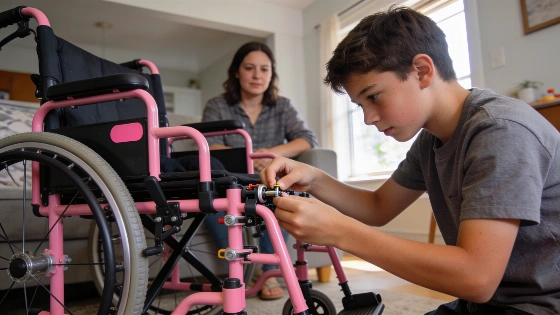
Zac Waters, 13, devoted his summer to designing and assembling a personalized wheelchair for a young child with mobility needs. The project, based on open-source plans, was tailored to grow with its user and included thoughtful details for daily comfort.
In Lehi, Utah, 13-year-old Zac Waters dedicated nearly 300 hours of his summer break to a project that would change a family's daily life. Using open-source plans from MakeGood, Zac built and customized a mobility chair for a 21-month-old girl who requires assistance to move independently. The story, first reported by ABC4 Utah on August 5, 2026, quickly drew attention beyond the United States as news of the teenager's commitment spread.
The device stands out for its adaptability. Zac modified the original MakeGood design to ensure the chair could be adjusted as the child grows, adding features like adjustable footrests and head support. He also included a removable cup holder, a tray table, and flexible straps for safety. The backrest was reinforced to accommodate heavier medical equipment if needed, and the chair was finished with pink accents, the child's favorite color.
From YouTube Inspiration to Real-World Impact
Zac's interest in 3D printing began with YouTube tutorials, but it was discovering MakeGood—a nonprofit connecting families with volunteers skilled in assistive technology—that set this project in motion. The organization provides open-source blueprints, allowing volunteers to fabricate devices at home using consumer-grade 3D printers. Zac spent his vacation preparing digital files, printing components, testing fits, and assembling the final structure. He described the process as a blend of his two passions: 3D printing and helping others.
Each stage required careful attention, from ensuring the modular parts fit together to making real-world adjustments for comfort and usability. The result is a chair that not only meets the child's current needs but can be adapted as she grows, reflecting a level of foresight often missing in standard pediatric mobility aids.
Designing for Growth and Everyday Life
The chair's modular construction means that as the child gets older, specific parts—like the footrest or headrest—can be swapped out or resized without rebuilding the entire device. This flexibility is especially valuable for families, as it reduces both cost and disruption. The use of PETG and TPU plastics, along with select metal components and auxiliary wheels, keeps the chair lightweight yet sturdy. According to MakeGood, the material cost for a single unit is around $150, making it accessible compared to commercial alternatives.
MakeGood's Toddler Mobility Trainer, the model Zac used, is designed for children aged one to eight and aims to foster independence, coordination, and social interaction. The organization offers the design files under an open license, enabling families and volunteers worldwide to produce the device with standard 3D printers. The average wait time for a volunteer-built chair is about 70 days, highlighting the demand for such solutions.
Family Support and Future Ambitions
Throughout the project, Zac's family provided steady support, likened by his grandmother to the bumpers in a bowling alley—guiding him while allowing room for experimentation. For the Waters family, the value of the project lies not in Zac's age but in the tangible improvement it brings to another child's life. Zac, meanwhile, sees this experience as a stepping stone toward a technical career and hopes to continue developing assistive devices for those in need.
Stories of young innovators using technology to solve real-world problems are not uncommon, but Zac's approach—combining open-source design, home fabrication, and personal dedication—offers a practical model for others. As noted in a related report on children adapting to unique challenges, such as the remarkable underwater vision skills developed by the Moken community's youth, the intersection of ingenuity and necessity can lead to solutions that reshape daily life.
While Zac did not invent the original design, his commitment to adapting and assembling the chair for a specific child demonstrates how accessible technology and community support can bridge gaps in care. The project stands as a reminder of the impact that focused effort and collaboration can have, especially when driven by a desire to help others.