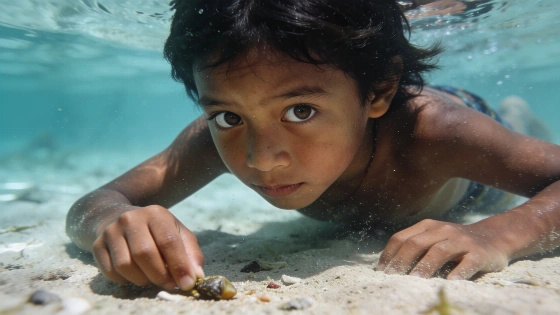
Some children from the Moken community have developed a rare ability to see sharply underwater, rivaling what was once thought possible for humans. Scientific studies reveal this skill is not genetic, but learned through intense training and adaptation.
In the waters of Southeast Asia, a group of Moken children have demonstrated an extraordinary ability: they can spot and retrieve small objects from the sea floor with a clarity that challenges the known limits of human vision. This phenomenon, recently brought back into public discussion by reports in August 2026, was first documented by scientists more than two decades ago.
Research published in 2003 in Current Biology revealed that Moken children could distinguish underwater patterns at a level more than twice as sharp as their European peers. The study, led by a team from Lund University, measured their visual acuity at 6.06 cycles per degree, compared to 2.95 for European children. This means the Moken could see much finer details while submerged, a skill that proved essential for their traditional way of life as sea nomads.
Functional Adaptation, Not Anatomy
Contrary to what one might expect, the advantage did not stem from anatomical differences in the eye. Instead, the children achieved this acuity by making two simultaneous adjustments: they contracted their pupils to just under 2 millimeters and forced their lenses to accommodate at the very edge of human capability—up to 16 diopters. These changes allowed them to compensate for the loss of focus that occurs when the eye is underwater, where the cornea’s refractive power is nearly neutralized by the surrounding water.
By narrowing the pupil, the depth of field increases and peripheral blur is reduced. The lens, meanwhile, changes shape to restore some of the lost focusing power. Together, these mechanisms enabled the children to see objects underwater with a sharpness that would otherwise require goggles.
Skill That Can Be Learned
Follow-up research published in Vision Research in 2006 tested whether this ability could be taught. European children underwent 11 sessions of underwater training over a month. By the end, they too showed marked improvements in underwater vision and pupil contraction. Remarkably, these gains persisted for months after the training ended, and after eight months, their acuity matched that of the Moken children under similar conditions.
This evidence suggests that the skill is not exclusive to the Moken or tied to genetics. Instead, it is a learned adaptation, made possible by the flexibility of the young human lens—a flexibility that diminishes with age, explaining why adults struggle to achieve the same results.
Not a True Dolphin Comparison
Despite the popular label “dolphin children,” the comparison is more metaphorical than scientific. Dolphins and other marine mammals have evolved specialized eye structures over millions of years. The Moken children, by contrast, use the same human optical system, simply pushed to its functional limits through repeated exposure and necessity. The studies did not compare their vision directly to that of dolphins, and the analogy serves mainly as a journalistic shorthand for their unusual underwater abilities.
It is also important to note that not all Moken children possess this skill, and the research reflects the abilities of those studied in specific conditions over twenty years ago. The findings do not guarantee that the trait persists throughout life or across the entire community.
Culture and Environment
The Moken have lived for generations in close relationship with the Andaman Sea, relying on diving for food and survival. This constant exposure from a young age creates the conditions for developing such visual adaptations. The research highlights how environment and practice can shape human abilities in ways that challenge assumptions about our biological limits.
For those interested in the scientific details, the primary sources are the 2003 Current Biology study on Moken underwater vision and the 2006 Vision Research paper on visual training. As noted by Talent24h, these findings continue to intrigue both scientists and the public, offering a rare glimpse into the plasticity of the human body when pushed by necessity and environment.