At just 14, Jia Mingxuan developed a low-cost irrigation system that collects water from the air without electricity. His invention, built in Inner Mongolia, earned a gold medal at the 2025 iENA fair in Nuremberg. The project is now drawing renewed attention for its potential impact on reforestation in dry climates.
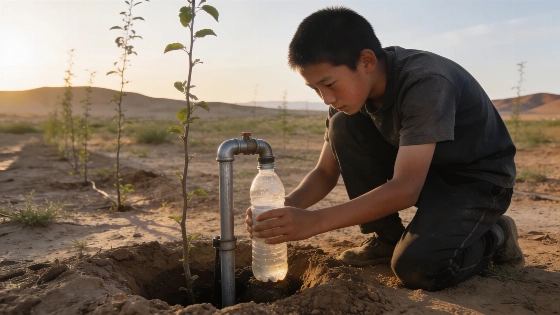
When Jia Mingxuan was asked by his teacher to come up with an invention, he noticed something familiar at home: water droplets forming on bathroom tiles from steam. That simple observation led the 14-year-old student in Inner Mongolia to design a prototype irrigation system that captures moisture from the air and delivers it directly to tree roots—without any need for electricity or external water supply.
Jia's device, assembled from steel pipes, reused bottles, and a wind-driven air intake, works by channeling humid air underground. As the air cools below the surface, condensation forms inside the pipe, and the resulting droplets trickle down to nourish the roots. The system relies on natural temperature differences and wind, making it especially suited for remote, arid areas where traditional irrigation is costly or impractical.
From School Project to International Recognition
The idea took shape in March 2025, after Jia connected his home observation to a physics lesson. He sketched out a system that could help young trees survive in dry soil by harnessing atmospheric humidity. Unlike many science fair models, Jia's prototype was repeatedly tested in real field conditions. He traveled nearly 30 kilometers from his boarding school to his family home to monitor the device, sometimes waking before dawn to dig up the system and measure soil moisture before returning to class.
Chifeng, the region where Jia lives, is part of China's Three-North Shelter Forest Program, which aims to combat desertification. Despite decades of reforestation, the area still faces low annual rainfall—about 380 millimeters—and watering saplings in remote locations remains a challenge. Jia's invention directly addresses this local need, channeling scientific curiosity into a practical solution.
Gold Medal at iENA 2025
Jia's project, officially titled "Automatic Tree Watering Device for Arid Regions," was presented at the 77th iENA International Trade Fair in Nuremberg in November 2025. Competing against more than 540 inventions from 21 countries, Jia's system stood out for its simplicity and potential impact. The jury awarded him a youth gold medal, recognizing his use of basic physical principles to solve a real-world problem. According to Xinhua, Jia attended the event in traditional Mongolian dress, marking his first trip abroad.
The iENA documentation lists Jia Mingxuan as the lead inventor, alongside several collaborators and educational institutions. While the award highlights the promise of his approach, it does not constitute full commercial or agronomic validation. The device's effectiveness still depends on local climate conditions, especially humidity, wind, and temperature swings between day and night.
Challenges and Next Steps
After receiving the gold medal, Jia began working with a research team in Shanghai to refine the design for broader use in reforestation projects. The next phase will test the system's durability against sand, corrosion, and long-term exposure, as well as identify materials that balance cost and longevity. So far, there are no published figures on daily water yield, unit costs, or independent comparative trials, making it too early to call the device a universal replacement for conventional irrigation.
What sets Jia's invention apart is its ability to channel condensation to tree roots using simple, affordable materials and no electrical infrastructure. While its performance will vary with environmental factors, the concept offers a promising tool for regions where water scarcity and high irrigation costs threaten reforestation efforts.
As reported by Talent24h, Jia Mingxuan's achievement is a reminder of how practical innovation can emerge from everyday observations—and how young inventors can contribute to solving urgent environmental challenges.